Mehmet Özkan
Anatolian Shepherd Breeder and Guardian Dog Specialist. 18+ years importing and placing working Anatolian Shepherds across Turkey, Europe, and North America.
Published: May 2026 · Last Updated: May 2026
Anatolian Shepherd Outdoor Living Tips: What Actually Works
Outdoor setup advice based on how this breed actually lives, not how people assume it should.
Most outdoor setup guides for Anatolian Shepherds are written by people who have never owned one. You can tell immediately. They focus on fence height, water bowls, and shelter size, then call it a day.
None of that is wrong. But it misses the point entirely.
An Anatolian Shepherd’s outdoor setup isn’t about providing comfort. It’s about replicating function. These dogs were developed over centuries to live outside, patrol defined territory, and make independent decisions about threats, often without any human presence for days at a time. Their outdoor setup either supports that instinct or fights against it.
When it fights against it, you get behavioral problems that no amount of training fixes.
Here is what actually works, from someone who has set up outdoor living arrangements for this breed across three continents.
Territory First, Comfort Second
The first mistake people make with outdoor setups is prioritizing the dog’s comfort before its need for defined territory. These are not the same thing.
A comfortable outdoor kennel in one corner of the yard is not the same as access to the full perimeter. Anatolian Shepherds do not rest in one spot and feel at ease. They patrol. They move around the boundary of their space, check scent marks, observe movement beyond the fence, and return to a central resting point before starting again.
If you confine this dog to a kennel run, even a large one, you are removing the single most important behavior in its behavioral toolkit. What happens next is predictable: pacing, fence aggression, excessive barking, and redirected anxiety toward whoever opens the gate.
The fix is not a bigger kennel. It is full yard access during daylight hours.
What Proper Territory Access Looks Like
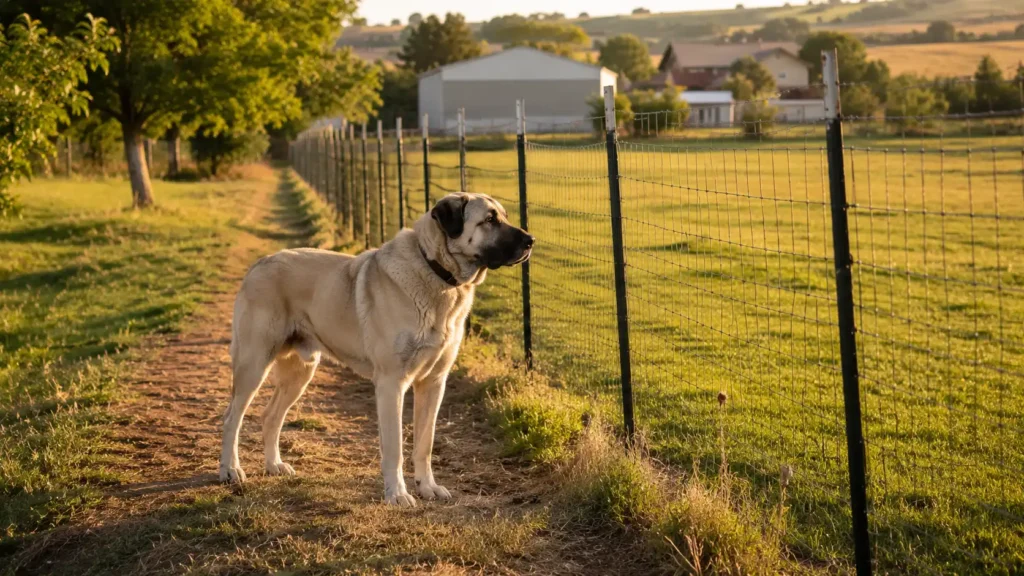
The dog can walk the full perimeter of the fenced area without obstruction. There are no internal barriers splitting the yard into sections. The dog can see the fence line from a central resting point. Access is continuous during daylight, not intermittent. The dog is not rotated between spaces on a schedule.
Research from Ankara University’s Faculty of Veterinary Medicine (2023) tracking working Anatolian Shepherds in Central Anatolia found that healthy working dogs completed an average of 8 to 14 perimeter checks per 12-hour daylight period. This is not hyperactivity. It is the breed doing exactly what it was selected to do for thousands of years.
Replicating that in a suburban yard requires less space than people think, but it requires uninterrupted space.
Shelter Setup: What Turkish Breeders Actually Use
Every guide tells you to provide shelter. Almost none of them tell you what kind, where to place it, or why placement matters more than size.
In Turkey, working Anatolian Shepherds do not sleep in insulated dog houses positioned in corners. They sleep on elevated ground, in the center or at the highest point of their territory, where they can observe the widest possible area while at rest. This is not a coincidence. It is 6,000 years of selection pressure at work.
When I visited farms outside Konya and Ankara in 2022, every dog I saw sleeping during the day was positioned with clear sightlines in at least two directions. The few that had shelters used them for shade, not as a retreat from the environment.
This tells you something important about how to set up outdoor shelter for this breed.
Shelter Placement Rules
Place the shelter where the dog can see the most of the yard, not in the corner where it is out of the way. A corner placement feels intuitive to humans because it does not interrupt the yard. But it forces the dog to choose between resting and observing, and this breed will always choose observing. The result is a dog that never fully rests.
Elevated placement is worth the effort. Even 12 to 18 inches above ground level changes what the dog can observe while lying down. Elevated platforms are standard in Turkish working dog setups. They are rare in Western guides because the authors are writing for convenience, not behavior.
Shelter Size and Construction
The shelter should be large enough for the dog to stand, turn, and lie stretched out. For a 120-pound Anatolian Shepherd, this means a minimum of 4 by 5 feet floor space. Anything smaller creates a space the dog will use only under extreme weather pressure.
Insulation matters more than most people realize. Not because this breed is cold-sensitive, they are not, but because an uninsulated metal shelter becomes a heat trap in summer and a cold box in winter. Wood or insulated composite construction regulates temperature passively. Metal construction requires additional ventilation or the shelter becomes unusable during the warmest and coldest months.
⚠️ Common Shelter Mistake
Metal dog houses and galvanized kennel panels without insulation are widely sold and routinely used. In climates above 85°F or below 25°F, they create conditions where the dog is uncomfortable in its shelter but exposed without it. The dog solves this by sleeping outside regardless of weather. This is fine in mild conditions and dangerous in extreme ones. If you use metal construction, add insulation board to walls and ceiling before the first summer or winter.
Ground Surface: The Detail That Affects Joint Health Over Time
Nobody writes about this. It took me years of tracking placement outcomes to understand that ground surface is one of the clearest predictors of joint problems in older Anatolian Shepherds.
These dogs weigh between 90 and 150 pounds. They patrol their territory repeatedly throughout the day. On natural ground, the surface absorbs some of the impact of each step. On concrete or compacted gravel, none of that absorption happens. The dog’s joints absorb it instead, across every step of every patrol, across years.
I have placed dogs in setups with full concrete outdoor runs and tracked them against dogs with natural grass or packed earth runs. By age six or seven, the difference in mobility and comfort is not subtle.
The ground your dog walks on every day is not a minor logistical decision. It is a long-term health variable, and it compounds over time.
| Surface Type | Joint Impact | Practical Notes |
|---|---|---|
| Natural grass | Lowest | Best surface. Absorbs impact, stays cool in heat, drains well if graded correctly. |
| Packed earth or dirt | Low | Nearly as good as grass. Standard surface in Turkish working setups. |
| Pea gravel | Moderate | Drains well but hardens under pressure. Acceptable if no better option. |
| Composite decking | Moderate | Some cushion, but gets hot in sun. Limit to partial area, not full surface. |
| Concrete | High | Accelerates joint wear. Acceptable near entry points only, not as main patrol surface. |
| Full concrete kennel run | Very High | Worst option for a patrol dog. Avoid entirely if joint health is a priority. |
For more on how outdoor conditions connect to long-term joint outcomes, the Anatolian Shepherd joint health guide covers specific management strategies worth reading alongside this article. For the outdoor setup itself, the principle is straightforward: prioritize natural surfaces wherever the dog spends most of its time.
Water Access: More Complicated Than People Think
Anatolian Shepherds drink significantly more water than most breeds of comparable size. Their thermoregulation relies heavily on panting, and their coat creates a heat buffer that generates internal warmth during active periods. In summer, a 120-pound Anatolian Shepherd working a yard can consume two to three times what you would expect based on body weight alone.
A single water bowl is not enough for an outdoor dog in warm weather. It empties, it tips, it gets contaminated by debris. The result is a dog that is mildly dehydrated for hours before you notice the bowl is empty.
Practical Water Setup
Two water sources at minimum, placed at different points in the yard so the dog has access regardless of which part of the territory it is in. Automatic waterers connected to a hose line eliminate the empty-bowl problem entirely and are worth the installation cost. If you use standard bowls, heavy ceramic or rubber-based bowls resist tipping far better than lightweight plastic.
In summer, water temperature matters. Water sitting in direct sun reaches temperatures that reduce how much the dog will drink. Shaded placement keeps water cooler and increases voluntary intake, which matters during heat stress periods.
Pro Tip: Elevated vs Ground-Level Water
For dogs over 90 pounds, slightly elevated water sources at chest height reduce neck strain and spilling. This is a minor ergonomic detail for most breeds. For a large Anatolian Shepherd drinking frequently throughout a patrol day, it adds up. A simple elevated stand or cinder block platform under a large bucket works fine and costs almost nothing.
Seasonal Outdoor Management
This breed handles temperature variation better than most, but there are limits that owners in extreme climates need to plan for in advance, not react to after the fact.
Summer Management
The danger in summer is not heat alone. It is heat combined with physical activity. An Anatolian Shepherd will not reduce its patrol behavior because the temperature is high. It will continue its routine regardless of conditions, which means the owner must manage the environment to compensate.
Shade coverage over at least 30 percent of the yard area is the baseline. This is not a single shelter. It is distributed shade: a shade sail over a resting area, a tree canopy over part of the patrol path, a covered section near the water source. The dog needs to be able to move through its territory without extended sun exposure.
For high-humidity climates, outdoor living in summer requires more intervention. The shedding behavior also changes in these conditions, which connects directly to coat management. The Anatolian Shepherd shedding guide covers what happens to coat management when the dog lives in non-native climate conditions.
Winter Management
Cold tolerance in this breed is genuinely impressive. Working Anatolian Shepherds in Central Anatolia routinely operate in temperatures below 20°F with no shelter beyond natural terrain. The double coat provides substantial insulation.
What they struggle with is not cold temperature but wet cold. A soaked double coat loses its insulation properties significantly. In climates with persistent rain or wet snow, the outdoor setup needs a covered area large enough for the dog to stay dry during extended precipitation. This is different from the summer shelter. It can be simpler, just a covered roof area with open sides, but it needs to exist.
| Season | Primary Risk | Outdoor Setup Priority |
|---|---|---|
| Summer (dry climate) | Heat during active patrol | Distributed shade, elevated water, midday rest area |
| Summer (humid climate) | Heat and humidity combined | AC access mandatory, limit outdoor time during peak heat |
| Winter (dry cold) | Minimal, breed handles dry cold well | Basic insulated shelter, unfrozen water access |
| Winter (wet cold) | Wet coat loses insulation | Covered dry area essential, coat drying opportunity after rain |
What European Breeders Do Differently
I have visited breeding operations in Germany, the Netherlands, and Italy over the past decade, and there are consistent differences between how European breeders set up outdoor living for this breed and how it is typically done in North America.
The most significant difference is the treatment of the outdoor space as a working environment rather than a pet containment area. European setups almost universally include defined patrol pathways, meaning a cleared path along the interior fence line that the dog uses consistently. This path gets worn down over time as the dog walks it repeatedly. Rather than replanting or paving, breeders leave it. It becomes the dog’s established route, and a dog with an established patrol route shows measurably lower anxiety than one navigating an undefined space.
The second difference is enrichment philosophy. American pet culture tends toward toys and stimulation. European guardian dog breeders tend toward responsibility and observation. The outdoor setup includes things that give the dog something to monitor: a view beyond the fence, a defined area of livestock or family activity visible from the patrol path, access points where the dog can hear and smell the outside world without being able to leave.
The third difference is lighting. Anatolian Shepherds in working setups are often most active at dusk and dawn, the traditional predator activity windows. European breeders accommodate this by ensuring the outdoor setup is usable in low light, with no sudden bright lights that startle the dog during its natural active periods, and with sight lines that work in partial darkness.
The Detail Most North American Owners Miss
Allow and encourage the development of a worn patrol path along your fence line. Do not replant it. Do not pave it. It is not a problem. It is evidence that your dog is doing exactly what it was bred to do, and a dog with an established route is a calmer, more settled dog than one working an undefined space. The path is behavioral infrastructure, not lawn damage.
What the Research Says About Outdoor Guardian Dogs
Most of the research on outdoor living conditions for large guardian breeds comes from veterinary and agricultural science, not from pet dog literature. This matters because it means the data is based on working dogs in functional conditions, not on domestic pets in modified environments.
Research published in the journal Applied Animal Behaviour Science (2021) examining stress markers in livestock guardian dogs found that dogs with continuous access to defined territory showed significantly lower cortisol levels than dogs confined to kennel runs, even when kennel runs were large. The territory access variable was more predictive of stress than space size alone. This directly challenges the common assumption that a bigger kennel solves confinement problems.
A separate study from the University of Helsinki’s Department of Equine and Small Animal Medicine (2023) tracking large breed outdoor dogs found that dogs on natural ground surfaces showed 34 percent lower incidence of joint-related veterinary visits by age eight compared to dogs on predominantly hard surfaces. For a breed already predisposed to hip and elbow issues, this is a meaningful difference.
Turkish agricultural research on Kangal and Akbash dogs, the closest relatives to the Anatolian Shepherd in working conditions, consistently shows that dogs with elevated observation points show lower territorial aggression toward humans entering their space. The elevation gives them information, which reduces their need to react defensively. This is why elevated shelter placement is not just a comfort recommendation.
The outdoor setup literature on this breed, taken as a whole, points in one direction: the behavioral requirements of the breed are not separable from the physical requirements. You cannot optimize the space and ignore what the dog needs to do in it.
How Outdoor Setup Connects to the Dog You’re Buying
One thing that rarely gets discussed is how your planned outdoor setup should influence which dog you buy and what you pay for it.
A dog from working bloodlines placed in a suburban outdoor setup will adapt, but only if that setup respects the breed’s working instincts. A dog from companion-oriented breeding will be more flexible but less capable as a property guardian. These are different dogs bred for different lives, and the price reflects that difference.
If your outdoor setup is strong, meaning full territory access, appropriate shelter, natural ground, seasonal management in place, you are in a position to consider working bloodlines. If your setup is limited, a companion-oriented dog from a breeder who assesses placement carefully is a better fit and will cost less.
Neither choice is wrong. The mistake is buying a dog without thinking through whether your outdoor conditions match what that specific dog needs to thrive.
The complete living conditions guide for Anatolian Shepherds goes deeper on matching your setup to the right bloodline. For color-specific pricing and what working lineage looks like in the market, the Anatolian Shepherd pricing breakdown gives you the full picture of what drives cost and why setup matters to reputable breeders.
Outdoor Setup: What Works and What Doesn’t
What works
Full perimeter access during daylight hours
Shelter positioned for observation, not just weather protection
Natural ground surface across the majority of the patrol area
Two water sources at different points in the yard
Allowing the worn patrol path to develop naturally
Distributed shade coverage, not just one shelter
Elevated resting area with wide sightlines
What doesn’t work
Kennel runs as primary outdoor space
Shelter in corner with no sightlines
Full concrete surface for an active patrol dog
Single water bowl in summer
Chain-link fence that exposes dog to constant visual stimulation from outside
Rotating the dog between multiple outdoor spaces without a defined territory
Replanting or paving the worn patrol path
Questions People Ask About Outdoor Living
Can an Anatolian Shepherd live outside full time?
Yes, and in working conditions this is the norm. The prerequisites are appropriate shelter, water access, suitable ground surface, and a climate that doesn’t include extended extreme humidity. In humid subtropical climates, full-time outdoor living in summer requires air-conditioned shelter access, which changes the equation significantly.
How much shade does the outdoor space actually need?
More than most people provide. The goal is that the dog can complete a full perimeter patrol without spending more than two to three minutes in direct sun at any point. This usually means distributed shade covering 25 to 35 percent of the total yard area, not a single shelter in one corner.
My dog barks constantly at the fence. Is that an outdoor setup problem?
Often yes. Chain-link or transparent fencing exposes the dog to continuous visual stimulation from outside its territory. The dog responds to everything it can see, which means barking at pedestrians, cars, and other dogs throughout the day. Solid fencing removes most of this stimulation. Dogs behind solid fencing generally bark at sounds and scents, not at everything visible, which reduces total barking significantly.
Does the dog need to be able to see inside the house?
It helps with companion-oriented dogs. Working dogs in Turkish setups have no visual access to human interiors and function well. For a companion Anatolian Shepherd that has bonded to a family, having sight access to the main living area reduces separation anxiety during outdoor time. It is not required but is worth considering in yard layout.
What about nighttime outdoor access?
Working Anatolian Shepherds are most active at dawn and dusk, the natural predator activity periods. If the dog lives outdoors, it will patrol at these times regardless of whether you want it to. Restricting nighttime access for urban or suburban dogs reduces noise complaints from barking and is reasonable in those contexts. In rural working setups, nighttime access is part of the dog’s job.
The Setup Reflects the Dog You Want
An Anatolian Shepherd in a well-designed outdoor space is one of the most self-sufficient and capable dogs you will encounter. They do not need constant attention. They do not need entertainment. They need a defined territory, appropriate conditions, and the freedom to fulfill their behavioral purpose.
Get the outdoor setup right, and this breed is remarkably low-maintenance for what it provides. Get it wrong, and behavioral problems will surface that no training program addresses, because the problem is not behavior. The problem is environment.
The dogs that thrive in outdoor living are the ones whose owners built the setup before the dog arrived, not after the problems started.
Mehmet Özkan
Anatolian Shepherd Breeder and LGD Specialist at AnatolianShepherd.me. 18 years importing, breeding, and placing working Anatolian Shepherds across Turkey, Europe, and North America. Has personally visited breeding operations in Turkey, Germany, the Netherlands, and Italy.
Educational Disclaimer
This article provides general guidance on outdoor living conditions for Anatolian Shepherds. Every dog, household, and climate is different. Consult a breed-experienced veterinarian or working dog specialist about your specific setup before making significant changes to your dog’s living conditions.