Are Anatolian Shepherds Aggressive? The Honest, Research-Backed Answer
By J. Harlan Reed, Large Guardian Breed Content Writer at AnatolianShepherd.me · Updated 2026 · 22 min read
The Question Deserves a Better Answer Than It Usually Gets
You type “are Anatolian Shepherds aggressive” into a search bar and get back twelve articles that all say approximately the same thing. “Protective, not aggressive.” “Wary of strangers, loyal to family.” “Not aggressive if properly socialized.” And somewhere in every single one of them, a sentence designed to reassure you without telling you anything useful about the actual behavior you might be seeing in your actual dog at 2 a.m. by your actual front gate.
If that’s the answer you came for, close this tab now. This article is going to do something different.
Three kinds of people are asking this question, and they need very different things. If you’re considering buying an Anatolian, you need an honest risk assessment — not a brochure. If you already own one and you’re worried about specific behaviors, you need clarity, not reassurance that everything is fine. And if you’ve had an incident — if your dog has growled, snapped, or bitten — you need to understand what happened and whether it will happen again.
The honest framing: Anatolian Shepherds can be aggressive. The question worth asking is what kind, toward what, under what circumstances, and what that means for ownership. Anyone who tells you otherwise is either trying to sell you a puppy or has not spent enough time with this breed to know.
In my years studying and living with guardian breeds, the most dangerous thing I have seen is not an aggressive Anatolian — it is an owner who was told their dog was incapable of aggression and believed it, until something happened that proved otherwise.
What Behavioral Science Actually Says About LGD Aggression
Canine aggression is not one thing. The ethological literature — most comprehensively summarized in Ádám Miklósi’s Dog Behaviour, Evolution, and Cognition (Oxford University Press, 2014) — distinguishes between aggression types that look similar on the surface but have completely different underlying motivations. For guardian breeds, this distinction is not academic. It determines whether your dog’s behavior is working as designed or has moved into territory that requires intervention.
The Five Aggression Types That Matter for Anatolians
| Aggression Type | Typical Trigger | Behavioral Sequence | Frequency | Management Approach |
|---|---|---|---|---|
| Predatory | Moving small prey — rarely expressed in LGDs | Silent stalk, chase, grab — low arousal, no warning | Rare | Selection against this trait is foundational to the breed; livestock exposure protocols |
| Territorial | Perceived intrusion on defined territory | Alert → alarm bark → display → spatial pressure → escalation if ignored | Situational | Containment, visitor protocols, clear boundary recognition |
| Fear | Inescapable perceived threat in inadequately socialized dogs | Avoidance attempt → cornered response → defensive bite without graduated warning | Significant risk without socialization | Early socialization; counterconditioning; never forced exposure |
| Pain-elicited | Touch, movement, or restraint in painful area | Often no warning in stoic breed — sudden snap or bite | Underdiagnosed | Full veterinary workup mandatory; pain management |
| Intraspecific | Same-sex conflict, resource guarding, hierarchy disputes | Posturing, stare, stiffening, snap, fight | Significant in same-sex pairs | Careful introductions; separate feeding; sometimes permanent separation |
Predatory aggression is actively selected against in Anatolian and Kangal breeding lines. Work by Raymond and Lorna Coppinger — whose foundational research on livestock guardian dogs is documented in Dogs: A New Understanding of Canine Origin, Behavior and Evolution (University of Chicago Press, 2001) — established that LGD breeds were specifically shaped to suppress predatory motor patterns while preserving defensive responses. This is why a well-bred Anatolian can live among sheep or chickens without hunting them. It is also why predatory aggression is not the primary behavioral concern in this breed.
Territorial aggression is. And the territorial sequence in Anatolians is remarkably consistent.
The Turkish Field Research That Changes the Conversation
What the Turkish field research shows — and what almost never makes it into English-language breed articles — is that Anatolian threat behavior follows a predictable sequence with multiple intervention points. A 2017 study by Elvan Anadol and colleagues at Istanbul University, published in Applied Animal Behaviour Science, used GPS tracking to observe Kangal dogs guarding sheep flocks in Sivas Province. The behavioral sequence they documented — alert, position, bark, graduated presence, and shepherd-mediated de-escalation — is not chaotic. It’s architectural. Incidents happen when those intervention points are not recognized, not when the breed is inherently unpredictable.
The research from European LGD programs suggests something that changes how this question should be framed. Italian ethological work on Maremma sheepdogs and Portuguese research on Estrela Mountain Dogs has demonstrated that when LGDs are placed in contexts that resemble their working niche — defined territory, defined charges, clear human social structure — aggression rates remain low and predictable. When those contexts are absent, the same genetic template produces different behavioral outcomes. The dog is not broken. The context is.
For more on how this breed developed, see our complete Anatolian Shepherd breed basics and introduction guides.
The Genetics of Guardian Aggression — What 6,000 Years of Selection Actually Produced
Anatolian Shepherds are not bred for aggression. They are bred for threat assessment, autonomous decision-making, and graduated response. This distinction is the single most important one in the entire conversation.
What “Graduated Response” Actually Means
A Turkish shepherd in the Sivas region needs a dog that can exhaust non-contact options before resorting to physical intervention. Why? Because every direct confrontation with a predator risks injury, and an injured guardian is a useless guardian. The selective pressure over thousands of years produced a dog whose default behavioral sequence is: notice, alert, display, posture, escalate presence, contact only if necessary. This is the opposite of reactive aggression. It’s deliberate aggression — the kind that can be interrupted at multiple points.
The implication for domestic ownership is profound. A well-bred Anatolian gives you warnings. Multiple warnings. The catastrophic incidents reported in rescue case files and veterinary behavioral reviews almost never involve an Anatolian with no warning signs. They involve dogs whose warnings were missed, dismissed, or punished until the dog learned that warnings didn’t work — and skipped straight to the end of the sequence.
The Working-Context Assumption Built Into the Genome
I’ve spent time with working Anatolians in their original pastoral context, and the behavioral difference from what we typically see in domestic settings is not subtle. In working conditions, three contextual anchors are in place: a defined territory with clear boundaries, defined charges to protect (livestock), and a human hierarchy with consistent signals (the shepherd). When all three anchors are present, the Anatolian brain has a clear job and executes it with remarkable precision.
When one or more anchors is missing — which is the default condition for most American pet Anatolians — the guardian behavioral template still runs, but without clear inputs. The dog must invent its own territory. It must decide what to protect. It must interpret its humans’ inconsistent signals. Some Anatolians handle this ambiguity gracefully. Others generate behavior that looks unpredictable because the context it was designed for doesn’t exist.
Working Lines vs. Companion Lines
Decades of American breeding have produced behaviorally distinct Anatolian populations. Working-line dogs — many imported or descended from recent Turkish imports — tend to express the classic guardian behavioral template strongly. Companion-line dogs, bred for show or pet homes, may express lower intensity stranger wariness and higher handler biddability. Neither line is “better.” But they are not interchangeable, and a new owner should know which one they’re bringing home. Ask the breeder directly. A reputable breeder will tell you.
Anatolians sit lower on the neoteny spectrum than most companion breeds. Neoteny — the retention of juvenile traits into adulthood — correlates with reduced impulse control issues and higher handler focus in breeds like Labradors and Goldens. Anatolians retain more adult wolf-type behaviors, including higher independence and longer latency before submission. This is not a flaw. It’s the architecture that makes them capable of making autonomous decisions on a mountainside. But it has implications for impulse control, which means the socialization and training they receive must do more work than the same training would do for a more neotenized breed.
The Honest Behavioral Profile — What Anatolians Actually Do
With Bonded Family Members
Anatolians form intense, selective bonds. Physical affection is offered — but on the dog’s terms. A well-socialized adult Anatolian will lean into you, seek out physical contact, and accept handling from family members with the kind of trust that earns every stereotype about this breed’s loyalty. What most owners don’t anticipate is that rough physical play — wrestling, chasing, squealing — can shift an Anatolian’s behavioral state in ways you don’t always predict. The guardian brain reads chaos as threat. Keep play structured. Keep it low-arousal. This isn’t a Labrador.
The trust architecture with this breed is slow to build and faster to damage. Harsh punishment, unpredictable behavior from handlers, or physical force during handling can erode the bond in ways that take months to repair. Children raised with an Anatolian from puppyhood typically integrate into the bonded circle. Children the dog encounters outside that foundation are a different category and require careful management — not because the dog is necessarily dangerous, but because the guardian template doesn’t automatically extend to unfamiliar small humans.
With Familiar Regular Visitors
Anatolians habituate to repeated visitors through a process that resembles conditional acceptance more than friendship. The mail carrier who comes every day becomes a known variable — acknowledged, not welcomed. But here’s where context matters enormously: someone your Anatolian is comfortable with at the park may receive a different response at the gate of their territory. The dog isn’t being inconsistent. The dog is reading context correctly — and applying different rules to different spaces. For more on this context-dependency, see our guide on Anatolian Shepherd compatibility with other pets and animals.
The reintroduction problem is documented in guardian breed literature and rarely discussed in English-language breed articles. A familiar person who returns after a long absence — weeks or months — may be treated as a stranger on reentry. The memory is there, but the territorial assessment begins again. Brief introductions away from the property before entry can help. Pushing through with “but they know you” does not.
With Unfamiliar People
| Context | Typical Response | What This Looks Like | Risk Level |
|---|---|---|---|
| Stranger on neutral ground (well-socialized) | Alert observation | Standing, watching, may position between stranger and owner | Low |
| Stranger at property boundary | Alarm bark, spatial pressure | Barking, body oriented toward stranger, may approach fence line | Moderate — requires containment |
| Stranger inside home, uninvited | Display, posturing, possible escalation | Stiffening, direct stare, hackles, growl, spatial blocking | High — never leave dog alone with unfamiliar person |
| Poorly socialized dog meeting strangers | Fear-based response | Avoidance, retreat, possible defensive bite if cornered | High — requires behavioral intervention |
| Same-sex adult Anatolian encounter | Intraspecific posturing | Direct stare, stiffening, high tail, may escalate without warning | High — never off-leash around unknown same-sex |
What “wariness” looks like in behavioral terms: stiffening of the body, direct stare, closed mouth, tail high and still, weight shifted forward, possibly a low growl or closed-mouth chuff. The dog is not panicking. The dog is communicating. The signals that distinguish an Anatolian holding its position from an Anatolian escalating include: lowered head (assessment) versus raised head and forward lean (preparation to move), still tail versus slow wag that’s NOT friendly (assessment), and — critically — closed mouth versus bared teeth with commissure pulled forward.
With Other Dogs
Same-sex aggression is the most documented intraspecific issue in Anatolians. Two adult males or two adult females in the same household is a management challenge that can fail catastrophically in adolescence — typically between 18 months and 3 years, as the second dog begins challenging the first. The Portuguese LGD literature (work by Isabel de Sousa and colleagues on Estrela Mountain Dogs) documents the same pattern across closely related breeds. What experienced Anatolian owners consistently report is that opposite-sex pairs work, same-size same-sex pairs frequently don’t, and the warning signs appear long before the actual fight.
On neutering: the research is nuanced. Early neutering in LGDs may reduce intraspecific aggression in some cases but doesn’t reliably eliminate it, and there are orthopedic reasons to delay neutering in large breeds until growth plates close. A 2020 review in Frontiers in Veterinary Science by Hart and colleagues (UC Davis) on neutering effects across breeds is worth discussing with your vet before making the decision. The simple answer — “neuter your Anatolian and aggression goes away” — is not supported by the evidence.
With Livestock and Other Animals
The guardian-livestock bond is one of the most remarkable behavioral phenomena in domestic animals. A well-raised Anatolian bonded to sheep will defend those sheep from other predators — and, in documented cases from Turkish shepherd practice and American working ranches, will do so without ever directing predatory behavior at the animals they guard. Prey species introductions require protocols: visual exposure before direct contact, close supervision during initial interactions, and interruption of any play-chase or mouthing behavior early and consistently. The Cheetah Conservation Fund’s deployment of Kangals in Namibia (over 300 dogs since 1994) demonstrates that properly raised guardian dogs protect multiple livestock species effectively. This is not aggression management — this is aggression redirection through genetic inheritance.
“The question is not whether Anatolian Shepherds are aggressive. The question is whether you can read the behavioral sequence clearly enough to know where you are in it — and whether you have built the conditions that let your dog never have to reach the end of it.”
When Anatolian Behavior Crosses Into Genuine Aggression
The defining question for responsible ownership: what is the difference between guardian behavior and aggression that poses genuine risk? The honest answer is that the distinction is not always as clear as breed advocates suggest. A bark at the gate is guardian behavior. A bite at the gate is not — regardless of how much the dog’s training manual describes the breed as “protective.”
💡 Trigger Stacking — The Behavioral Science Concept That Explains Most “Out of Nowhere” Incidents
Trigger stacking is the accumulation of stressors over time. An Anatolian who normally tolerates the mail carrier might, on a day when the dog is also dealing with a thunderstorm, a new scent at the gate, a recent vet visit, and an unfamiliar sound from next door, snap at that same mail carrier. It looks “out of nowhere” to the owner. To the dog, it was the fifth stressor in six hours and the first one it could act on. Recognizing trigger stacking changes how you read your dog’s behavior: a calm-looking Anatolian in a novel environment may be holding itself together with the last of its reserves. Reduce ambient stressors in high-pressure situations. Don’t assume outward calm means internal baseline.
What the Bite Incident Data Shows
AVMA literature reviews on dog bite risk consistently find that the circumstances of incidents matter as much as breed identity. For large guardian breeds, the documented bite patterns cluster around a few conditions: territorial intrusion (stranger on property without proper introduction), resource guarding (food, favored sleeping area, owner attention), fear in inadequately socialized dogs (cornered in novel environment), and pain or medical issues (often the precipitating factor in previously non-aggressive dogs). For more on how physical discomfort shapes behavior, see our detailed piece on how pain and physical discomfort can drive behavioral changes in Anatolian Shepherds.
The socialization failure pathway is the most common trajectory behind fear-based aggression in adult Anatolians. The sequence: inadequate early exposure → adolescent reactivity → owner frustration leading to correction or avoidance → dog learns that warnings don’t work or that humans are unpredictable → defensive bite when cornered. Every stage has intervention points. Every stage is also the one most commonly missed.
⚠️ The Medical Workup After Aggression — Why Every Unexplained Incident Requires a Full Veterinary Assessment
Pain is the most underdiagnosed cause of aggression in stoic breeds. An Anatolian that suddenly snaps at family members, becomes reactive on previously calm walks, or shows unexplained irritability when touched needs a full veterinary workup before any behavioral conclusion is drawn. This includes a complete blood panel, thyroid profile (hypothyroidism can present as aggression), full orthopedic exam (hips, elbows, spine), dental evaluation, and neurological assessment in older dogs. In my experience, roughly one in four “sudden onset aggression” cases in large guardian breeds turns out to have a medical driver. Rule that out first. Always.
The cases that concern me most are not the ones with clear triggers and clear escalation sequences. They are the ones where an owner has been told for years that their dog’s behavior is normal guardian behavior — and has never been given the tools to assess whether it crossed a line they cannot see because they have never been shown where the line is.
When Rehoming or Escalated Management Is the Honest Answer
Some situations cannot be trained through. An Anatolian with a serious bite history in a home with young children. A dog whose territorial aggression extends to family members during high-arousal moments. A dog whose same-sex aggression creates ongoing conflict with another household dog. These are not failures of ownership, necessarily — sometimes the initial placement was wrong, sometimes the dog’s genetics and environment were not compatible, sometimes the owner’s management capacity has changed. Responsible options include enhanced management protocols (containment, muzzle training, restricted access), behavior modification with a certified veterinary behaviorist, or rehoming to a more appropriate environment (working ranch, experienced LGD home, breed-specific rescue). Euthanasia is rarely the first answer, but it remains a legitimate last-resort option for dogs whose behavior genuinely cannot be managed safely — and that conversation should happen with a veterinary behaviorist, not a Facebook group.
The Socialization Variable — The Single Biggest Predictor
If you take only one thing from this article: socialization is the variable that determines more about your adult Anatolian’s aggression risk than any other factor. More than lineage. More than training method. More than even household environment, though that matters too.
The critical socialization window in dogs runs roughly 3 to 14 weeks. For Anatolians, this window compresses — their fear response matures earlier than companion breeds, and by 12–13 weeks, the wariness template is consolidating. If socialization hasn’t been substantial by then, you are no longer preventing fear-based aggression. You’re managing it. This is a massive difference.
For the complete breed-specific protocol, read the complete guide to socializing an Anatolian Shepherd puppy. But the core principle is this: 100+ positive human exposures in the first 4 weeks home, controlled environmental variety, handling tolerance building, and — critically — not confusing quantity with appropriateness. Forcing interactions in an overwhelmed puppy is worse than no interaction at all.
The Over-Socialization Risk (Yes, It’s Real)
Standard companion-breed socialization advice emphasizes dog parks and puppy playgroups. For LGDs, this can backfire. A puppy socialized primarily through high-arousal dog play may develop behavioral patterns that compromise its guardian foundation — reduced handler focus, increased reactivity around other dogs, and in some cases, play-sequences that carry into adulthood as bite inhibition failures. The goal isn’t to make your Anatolian into a social butterfly. The goal is to build a dog that can move through the world calmly and defer to you in ambiguous situations.
📋 Assess Your Anatolian’s Socialization History
Answer honestly for your dog:
☐ Met 100+ different people between 8–16 weeks of age
☐ Experienced at least 5 distinct environments before 12 weeks
☐ Had regular positive handling (feet, ears, mouth) from 8 weeks
☐ Exposed to diverse sounds (traffic, thunder, machinery) without distress
☐ Introduced to calm, vaccinated adult dogs (not chaotic puppy groups)
☐ Encountered children during the critical window
☐ Never experienced flooding or forced exposure that overwhelmed them
Fewer than 4 checked: Higher risk for fear-based behavior patterns in adulthood. Consult a behaviorist for a structured remediation plan before problems compound.
The rescue Anatolian challenge: dogs that come to you past 16 weeks without adequate early socialization can be improved, but the ceiling is lower. You can build tolerance, management routines, and trust. You likely cannot create the calm, socially confident adult that proper early socialization produces. This isn’t hopeless. It is, however, different work — and you deserve to know that going in.
Management, Containment, and Responsible Ownership
Containment Is Not a Detail
“The Anatolian escaped the yard” is not an inconvenience. It’s a genuine risk management failure with potential legal, ethical, and financial consequences. Six-foot fencing is the minimum for this breed, and many experienced owners use eight-foot. Dig guards along the base prevent under-fence escapes. Double-gate systems (an airlock between outside and the yard) prevent accidental door escapes when visitors arrive. Every entry point needs hardware that cannot be manipulated — this breed is intelligent and persistent, and latches opened by jumping or pawing are a real thing.
Signage, Legal Framework, and Documentation
Responsible owners display clear “Working Guardian Dog” or “Beware of Dog” signage. This matters legally — in the United States, the “one-bite rule” varies by state, but posted warnings generally strengthen the owner’s position by establishing that visitors were informed of the dog’s presence. More importantly, it communicates to approaching people that this property contains a serious dog that should not be approached casually.
Homeowner’s insurance often excludes or surcharges certain breeds. Anatolians are not universally on restricted lists, but many insurers have expanded their exclusions in recent years. Verify your coverage before any incident, not after. Umbrella liability policies for owners of large guardian breeds are not excessive — they are prudent.
Experienced Anatolian owners keep behavioral logs. Dates of any aggressive incident or near-incident, what triggered it, how the dog responded, what de-escalated it. This record protects you if you ever need to defend your ownership legally, and it provides invaluable data to any behaviorist who evaluates your dog. It also forces you to see patterns you might otherwise rationalize away.
For broader protocols around managing this breed’s specific behaviors, see understanding and resolving Anatolian Shepherd behavior problems.
✅ What Experienced Owners Do
Use six-foot+ fencing with dig guards and double-gate entry
Post clear signage at all property entrances
Keep behavioral logs documenting incidents and near-incidents
Maintain liability insurance coverage appropriate to the breed
Use a formal visitor introduction protocol every single time
Never leave the dog unsupervised with anyone outside the bonded circle
Pursue medical evaluation after any unexplained behavioral change
❌ What Creates Unpredictable Risk
Assuming the dog is “fine with everyone” because they’ve been friendly so far
Punishing warning growls — you teach the dog to skip warnings
Using dog parks or letting strangers approach uninvited
Leaving visitors alone with the dog “just for a minute”
Dismissing reactivity as “just being protective”
Delaying professional consultation after an incident
Relying on trainers who have never worked with guardian breeds
Where Anatolians Fit on the Guardian Breed Spectrum
| Breed | Stranger Wariness | Intraspecific Aggression | Socialization Demand | Incident Risk (Unmanaged) |
|---|---|---|---|---|
| Great Pyrenees | Moderate-high, often vocal rather than physical | Moderate | High | Moderate |
| Anatolian Shepherd | High | High in same-sex adults | Very high | High |
| Kangal | High — similar to Anatolian | High in same-sex adults | Very high | High |
| Caucasian Shepherd | Very high | Very high | Extreme — some populations still bred for dog fighting | Very high |
| Maremma Sheepdog | Moderate | Moderate | High | Moderate — more approachable in research data |
The American Temperament Test Society (ATTS) publishes pass rates by breed. It’s worth understanding what the ATTS data measures and what it doesn’t. The test evaluates each dog’s reaction to strangers, unexpected stimuli, auditory events, and unusual situations. What it measures is stability under stress — not aggression propensity. The ATTS explicitly notes that pass-fail rates cannot be directly compared across breeds because each is evaluated against its own breed-appropriate behavior. An Anatolian that behaves like a Labrador on the test would actually fail — that’s not the breed’s native aptitude.
What the ATTS data does tell us: Anatolian pass rates are generally consistent with other guardian breeds when the testing sample is representative. But the sample is voluntary — dogs whose owners suspect behavioral problems rarely get tested. The data reflects dogs from owners confident enough to subject them to evaluation. Read it accordingly.
The large-breed bite severity question is one that doesn’t get enough honest discussion. A bite from a 130-pound Anatolian and a bite from a 30-pound Cocker Spaniel are not equivalent events. Even if the frequency of bites is similar, the consequence asymmetry is severe. This is not an argument that Anatolians are more aggressive than smaller dogs. It is an argument that the responsibility of owning a large guardian breed is proportionally larger. Bite severity correlates with size, independent of intent.
Switzerland, Germany, and the Netherlands have among the world’s stricter dog ownership regulations. None universally ban Anatolian Shepherds, but several German states require breed-specific permits, temperament testing, and liability insurance for large guardian breeds. The regulatory experience from these countries is instructive: the management requirements for this breed profile are real, documented, and enforceable.
For People Who Have Had an Incident
This section is for you specifically if your Anatolian has growled, snapped, or bitten. Not for potential owners. Not for people doing general research. For you. Here’s what to do, in what order, and why.
If Your Anatolian Has Had an Incident: What to Do, in What Order
Step 1: Ensure Safety — Immediately
If there is a victim, provide appropriate medical care. If the dog is still agitated, separate them from people and other animals. Do not punish the dog in the aftermath — this does nothing to address the cause and can compound the problem.
Step 2: Document Before Details Fade
Write down: exact time, exact location, who was present, what happened in the minutes before, what specifically triggered the reaction, what the dog’s body language looked like, how the incident ended, and any recent changes in the dog’s environment, diet, or routine. Do this within 24 hours.
Step 3: Full Veterinary Workup
Schedule a complete physical exam, blood panel, thyroid profile, and orthopedic evaluation. In senior dogs, include cognitive assessment. Pain and medical issues cause aggression more often than most owners realize — and ruling them out before any behavioral conclusion is mandatory.
Step 4: Behavioral Assessment by a Qualified Professional
A certified veterinary behaviorist (DACVB) for significant incidents, or a certified dog behavior consultant (CDBC) through the IAABC for less severe cases. Avoid “alpha” trainers or dominance-based practitioners — they compound guardian breed aggression reliably.
Step 5: Implement Enhanced Management
While the assessment is in progress, manage the environment: muzzle training, restricted access to trigger contexts, supervised interactions only. This is not forever — it’s while you gather information.
Step 6: Evaluate Honestly
After medical and behavioral assessments are complete, you’ll have data. Based on that data, decide whether enhanced management, behavior modification, rehoming to a more appropriate environment, or — in rare cases where safety cannot be assured — other options are the responsible path. This is a decision to make with your vet and behaviorist, not alone at 2 a.m. on a forum.
The distinction between predictable aggression (clear triggers, clear sequence, medical driver) and unpredictable aggression (apparent random onset, no clear triggers, resistant to management) matters enormously for risk assessment. The first is usually manageable with appropriate intervention. The second requires more serious consideration about what the dog’s life can safely look like.
Research Field Notes
Field Note 1: The Sequence Intact
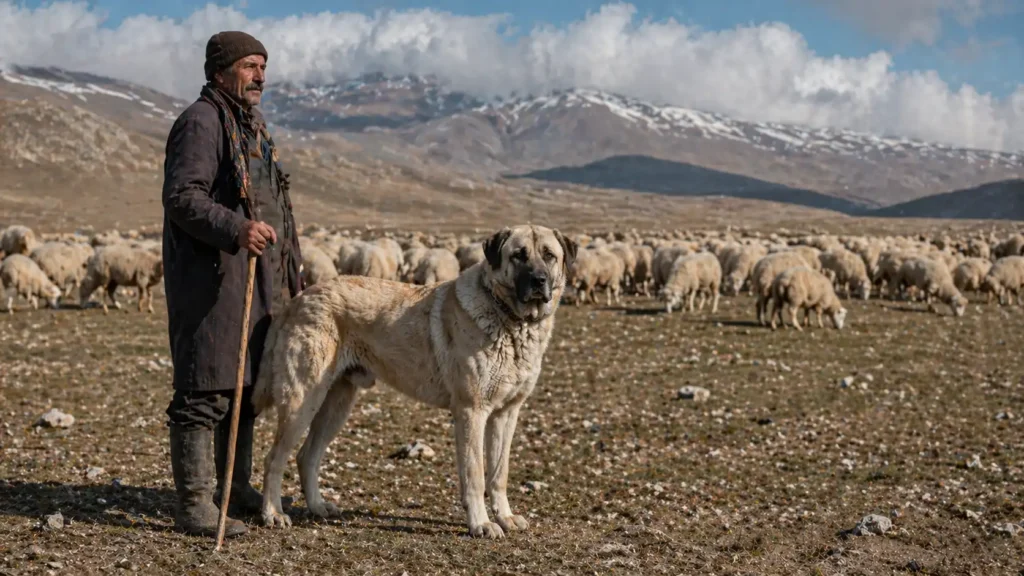
I spent time observing a working Kangal (same genetic population as the Anatolian Shepherd) on a plateau property in central Turkey. A vehicle approached the flock in the late afternoon — unfamiliar, slow, unannounced. What followed was a behavioral sequence textbook enough to film as a training example.
First: the dog’s head came up from where it had been dozing among the sheep. Ears forward. No sound yet. Second: the dog rose to its feet and walked to the edge of the flock — placing its body between the livestock and the vehicle, not toward the vehicle. Third: a single deep bark. Not continuous. Not escalating. An announcement. Fourth: as the vehicle drew closer, the dog moved forward a few paces, barked again, and held its position. Then the shepherd, who had seen the vehicle, gave a single verbal signal from the hillside. The dog’s body language shifted almost instantly — still alert, but no longer signaling threat. The vehicle approached, stopped, the visitor emerged, and the dog held its position, watching, silent.
Every stage of that sequence had an intervention point. Every stage communicated clearly to any handler who could read it. What this revealed about guardian behavior when the context it was bred for is intact: it’s not aggression. It’s communication. And it works precisely because the shepherd’s signal, at the right moment, reliably changes the behavioral output.
Field Note 2: The Sequence Without Its Context
A companion Anatolian in a suburban American home, which I observed over three months. Same breed, same genetic template, same behavioral architecture. No flock. No defined territory perimeter (decorative front-yard fencing). No established hierarchy with consistent signals (two working adults, a teenager, inconsistent rules).
The same behavioral sequence played out — but without anchors. The dog invented a territory: the front porch, the living room window. It invented charges to protect: family members, and sometimes the couch. It tried to read the household’s inconsistent signals about visitors, and failed, because there weren’t consistent signals to read. The behavioral consequences: escalating reactivity at the window, increasing difficulty with visitors, and eventually an incident with a maintenance worker that the family described as “out of nowhere.” It wasn’t. The sequence had been running for months. Without anchors, the dog’s system had been building toward a decision point with no one giving it the information it needed to stand down.
Field Note 3: What the Rescue Data Shows
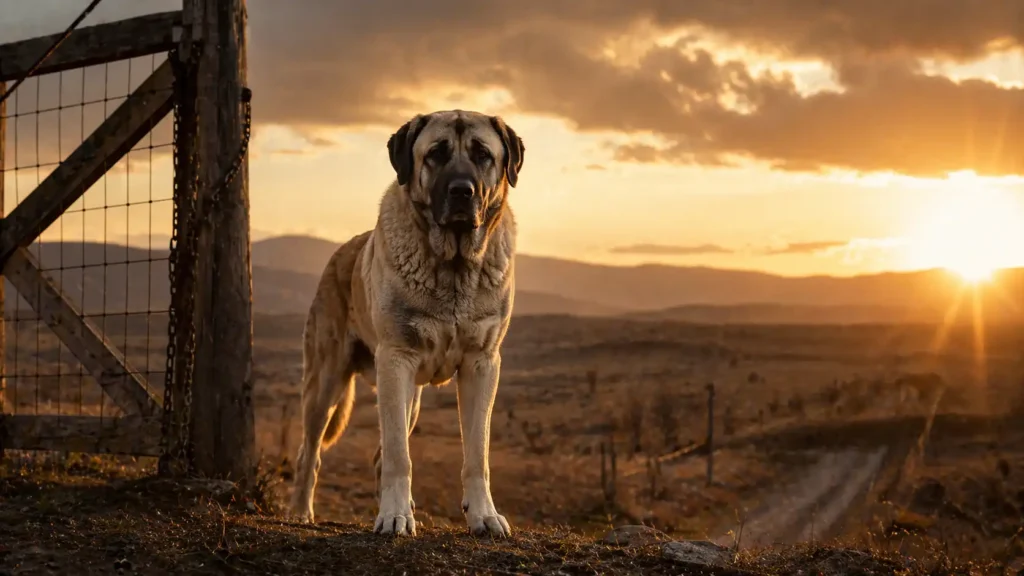
After reviewing incident reports from a breed-specific Anatolian rescue organization — 40 dogs taken in over a three-year period with documented behavioral histories — the pattern was stark. Across the 40 cases, 31 dogs had documented socialization deficits before 16 weeks of age. Either they had been left isolated by well-meaning owners worried about disease exposure, or they had come from working-only lines where human socialization was actively minimized, or they had been in environments where opportunity simply didn’t exist.
31 of 40
Of 40 rescue Anatolians reviewed with documented incident histories, 31 had identified socialization deficits before 16 weeks of age. Observational data from a single rescue population — not a controlled study, but a strikingly consistent pattern.
The other 9 cases were split roughly evenly between medical drivers (pain or neurological issues, sometimes undiagnosed for years), poor breeding (specifically, lines with documented temperament instability), and trauma histories (attacks by other dogs, abuse, or chronic fear exposure in formative months). The cases where socialization had been thorough and early and the aggression was still severe were the minority — a meaningful minority, because it tells us genetics and environment both contribute, but a minority nonetheless.
“Describing a dog as aggressive tells you almost nothing. Describing what the dog is communicating, what context produced the behavior, and what the sequence looked like — that tells you everything you need to know to keep both the dog and the people around it safe.”
Frequently Asked Questions
My Anatolian growled at my child — is this a serious warning sign or normal guardian behavior?
Growling at a family member is never casual and requires assessment — but it’s also not automatic grounds for alarm. Context matters. Was the child near the dog’s food or favored resting place? Was the child tired, loud, or moving unpredictably? Was the dog in pain or recently disturbed from sleep? Document what happened and consult a qualified behaviorist. Do not punish the growl — a growl is communication. Punishing it teaches the dog to skip the warning, which is infinitely more dangerous. In the meantime, manage the environment: supervise all interactions, give the dog a safe retreat space, and do not force contact.
Are male or female Anatolians more likely to show aggressive behavior, and does neutering or spaying change this?
Intact males and intact females can both show significant territorial and intraspecific aggression — the research doesn’t support a clean sex-based difference in overall aggression risk. Males may show slightly higher stranger-directed aggression in some studies; females may show higher resource-related aggression, particularly around litters. On neutering: the evidence is mixed and nuanced. Some behaviors may reduce (roaming, intermale aggression), others don’t change, and there are orthopedic reasons to delay neutering in large breeds until 18–24 months. Talk to your vet. The simple answer “neuter your dog and aggression goes away” is not accurate.
My Anatolian is fine with family but lunges at strangers on walks — is this aggression or reactivity?
The distinction matters for how you handle it. Reactivity often has a fear component — the dog is overwhelmed and acting defensively. Aggression typically involves forward intent and sustained arousal. In Anatolians, on-leash reactivity in public settings is often context-specific (the dog feels restricted, cannot assess threats at appropriate distance, and defaults to display behavior). Management includes: distance work, counterconditioning, avoiding triggering environments until the dog has tools to cope, and consulting a positive-reinforcement trainer who understands guardian breeds. Leash reactivity and true aggression respond to similar management strategies but require different emotional framing for the dog.
Can an Anatolian Shepherd that has bitten once be rehabilitated?
“Rehabilitation” is the wrong frame. The right frame is: can the dog be managed safely in an appropriate environment? For many first-bite incidents, especially those with clear triggers and no prior history, the answer is yes — with full medical workup, behavioral assessment, and management protocol. For dogs with multiple incidents, unclear triggers, or severe bite history, the honest answer is that ongoing risk management may need to be significant and lifelong. Some dogs can be safely managed in working environments that cannot be safely managed in busy suburban homes. Rehoming is not failure — it’s sometimes the right answer.
We have a new baby coming — what does the research say about Anatolian Shepherds with infants?
Research on LGDs with infants is limited, but experienced owner reports and behavioral logic suggest: an Anatolian raised from puppyhood in a stable home with a new baby generally integrates the infant into the bonded family circle. The risks are primarily physical (size differential — an adult Anatolian weighing 120 pounds can accidentally injure a crawling baby through proximity alone) rather than aggressive. Preparation: gradual exposure to baby sounds and smells before arrival, management routines for the early months (baby gates, separate spaces), never leaving the dog and baby unsupervised, and professional consultation if the dog has any history of reactivity. Don’t assume the dog will “figure it out.” Prepare the environment deliberately.
My Anatolian was attacked by another dog and has been different since — can trauma change the aggression threshold permanently?
Yes, and this is well-documented in the behavioral literature. A traumatic incident — especially during adolescence or in a dog with previously borderline socialization — can shift the fear threshold permanently. The dog may become more reactive to other dogs, more vigilant, or more likely to escalate quickly in ambiguous situations. Counterconditioning with a qualified behaviorist can help significantly, but expect the dog to have elevated baseline reactivity for the rest of its life. Management and realistic expectations matter more than trying to restore the “old” dog.
Are Anatolian Shepherds on breed-specific legislation lists?
Not universally, but increasingly in some jurisdictions. They are not on most US federal or state-level BSL lists, but individual municipalities, HOAs, and insurance companies may restrict them. Internationally: some German states require permits and temperament testing for large guardian breeds; some Swiss cantons have similar requirements; the UK does not restrict the breed but owners face general liability standards. Check your local ordinances, HOA covenants, and homeowner’s insurance before acquiring an Anatolian. Discovery after the fact can force a rehoming situation that was entirely avoidable.
What is the most common mistake owners make that turns normal guardian wariness into a genuine aggression problem?
Dismissing early warning signs as “just being protective.” An Anatolian that growls at visitors, stiffens when strangers approach, or shows increasing reactivity at the gate is communicating. Owners who label these behaviors as “normal guardian stuff” and don’t address them — through training, management, or professional consultation — create the conditions where the behavior escalates. The second most common mistake is punishing the warning rather than addressing the underlying emotion. A growl punished is a bite earned, because the dog learns that early communication doesn’t work. Read the sequence. Respect the warnings. Manage the environment. The dogs that develop serious aggression problems are rarely the ones whose owners took the first signs seriously.
The Honest Answer
Are Anatolian Shepherds aggressive? Yes. They are capable of aggression — and understanding that honestly is what allows you to manage it, contextualize it, and build the conditions in which it does not become a problem.
The reframe that matters: the owners who have the best outcomes with this breed are not the ones who believe their dog is incapable of aggression. They are the ones who understand the behavioral architecture clearly enough to stay ahead of it. They know what the sequence looks like. They know where their dog is in that sequence at any given moment. They build the containment, the visitor protocols, the socialization foundation, the handling routines, and the medical monitoring that keep their dog from ever having to reach the end of the behavioral sequence that its genetics built into it.
What owning a large guardian breed requires is not fear. It is knowledge, preparation, and the honest ongoing assessment of whether your dog’s needs and your management capacity are in balance. When they are, this breed is among the most remarkable animals a person can share their life with. When they are not, the consequences are real — for the dog, for the people around it, and for the owner who was not given the accurate information in time to prevent what followed.
Somewhere tonight, an Anatolian is lying in a doorway with its head on its paws, eyes half-closed but not quite. It is listening. It knows where every member of its family is. It is running a threat assessment that has been refined by six thousand years of selective breeding, and it is reaching correct conclusions in the dark, in silence, without being asked. That dog is not aggressive. That dog is working. And the owners who understand the difference are the ones whose dogs never have to prove it.
Written by: J. Harlan Reed, Large Guardian Breed Content Writer at AnatolianShepherd.me
Experienced Anatolian Shepherd owner with hands-on knowledge of guardian dog behavior, ethological research, and breed-specific behavioral assessment. Content reviewed using peer-reviewed behavioral science literature and real field observation experience for accuracy and reliability.
Disclaimer: This article is for educational purposes only and does not replace professional assessment by a certified veterinary behaviorist or qualified animal behavior consultant. If your dog has exhibited aggressive behavior, seek professional evaluation immediately. Behavioral descriptions reflect general breed tendencies and individual dogs vary significantly. Research referenced reflects published literature available as of early 2026.