How to Socialize an Anatolian Shepherd Puppy: The Complete Guide for New Owners
By J. Harlan Reed, Large Guardian Breed Content Writer at AnatolianShepherd.me · Updated 2026 · 17 min read
The Anatolian Puppy Paradox
You’re sitting on the living room floor at 10 p.m. with a socialization checklist you printed from a website written for Golden Retriever owners. It says to “encourage your puppy to greet everyone enthusiastically.” Your 10-week-old Anatolian is planted three feet from your neighbor, studying him with an expression that looks less like a puppy and more like a night security guard running a background check. She hasn’t moved in four minutes. Your neighbor asks if something is wrong with her.
Nothing is wrong with her. She’s doing exactly what six thousand years of selective breeding designed her to do. And the guide you’re holding is going to steer you in the wrong direction if you follow it.
This is the core paradox of owning an Anatolian Shepherd puppy: you need to socialize this dog enough that she can move through the human world safely — but socializing her the way you would a companion breed can actually undermine the guardian instincts that make her what she is. Push too hard, and you build anxiety. Don’t push at all, and you’ll spend years managing a dog who can’t distinguish between a mail carrier and a genuine threat.
As an Anatolian Shepherd owner, I learned very quickly that the socialization window for this breed is not just a timeline — it is a narrow, irreplaceable opportunity that you either use correctly or spend years compensating for. This guide is the one I needed and couldn’t find.
What “socialization” means for a Labrador — making friends with the whole world — is fundamentally different from what it means for a livestock guardian breed. For an Anatolian, socialization means building a framework of understanding: here are the things that exist in the world, here is what is normal, and here is what requires your attention. The goal is not a friendly dog. The goal is a discerning one.
Understanding What You Are Actually Working With
Before you start any socialization protocol, you need to understand the brain sitting behind those amber eyes. This is not a dog that was bred to look to humans for direction. This is a dog that was bred to make independent threat assessments on a Turkish mountainside while the shepherd was half a mile away and asleep.
That neurological wiring doesn’t disappear because the puppy lives in a suburb now. Whether your Anatolian will guard livestock or guard your living room, the same processing architecture is running underneath. And if you don’t account for it, every socialization effort will feel like pushing water uphill.
The Three Hardwired Responses
1. Stranger wariness. This is a feature, not a defect. Many Anatolian Shepherd owners don’t realize that their puppy’s wariness around strangers at 10 weeks is not a socialization failure — it is the breed doing exactly what it was designed to do. The goal is not to eliminate that wariness. The goal is to give it context. A well-socialized Anatolian doesn’t love strangers. They can assess strangers calmly and defer to your judgment about who is welcome.
2. Territorial boundary instinct. This begins expressing far earlier than most owners expect — some Anatolian puppies start showing territorial awareness at 8–10 weeks. That 18-pound ball of fluff who seems to be casually sitting by the gate is actually already mapping the boundary. Understanding identifying a purebred Anatolian Shepherd and their working origins helps explain why this instinct runs so deep.
3. Bonding selectivity. Anatolians choose their people carefully, and that process cannot be rushed. If you’ve wondered about how Anatolian Shepherds form bonds with their people, the short answer is: slowly, deliberately, and on their terms. Forcing affection on this breed doesn’t build trust — it erodes it.
Where Anatolians Sit on the Guardian Spectrum
Among livestock guardian breeds, Anatolians are on the more challenging end for socialization. Great Pyrenees tend to be somewhat more tolerant of strangers. Kangals — close genetic relatives of Anatolians — share similar wariness but can be slightly more handler-focused. Caucasian Shepherds make Anatolians look outgoing by comparison. Your Anatolian sits in a specific spot on this spectrum, and puppies from working lines often express wariness earlier and more intensely than those from companion-focused lines. Ask your breeder what their dogs are bred for — the answer shapes what you’re working with.
The Difference That Matters
An overwhelmed Anatolian puppy: tries to flee, tucks tail, pants heavily, won’t take food, whale-eyes.
A cautiously processing Anatolian puppy: stands still, ears forward or slightly back, watches intently, may sniff the air, does not approach but does not flee.
The second dog is doing their job. Let them.
The Socialization Window — What It Is and Why It’s Unforgiving
In all dogs, the primary socialization window runs roughly from 3 to 14 weeks. During this period, the puppy’s brain is wired to categorize novel experiences as “normal parts of the world” rather than “potential threats.” After the window closes, that default flips. New things become suspicious until proven safe — instead of safe until proven suspicious.
For Anatolians, this window effectively compresses. Their fear response matures earlier than most companion breeds. Where a Golden Retriever might stay socially open through 16 weeks, many Anatolian puppies begin consolidating their wariness by 12–13 weeks. You have less time, and the stakes are higher, because the adult version of this dog will weigh 120 pounds and have opinions about who belongs on your property.
| Age | Priority Focus | What Changes | Urgency |
|---|---|---|---|
| 3–7 weeks | Breeder’s responsibility — handling, sounds, siblings, surface variety | Brain is maximally receptive; fear responses not yet active | Critical — Breeder Phase |
| 8–10 weeks | People volume, gentle environments, household sounds, handling | First fear imprint period often appears (8–10 weeks); social curiosity still open | Critical — Act Now |
| 10–12 weeks | Expand environments, controlled challenges, other animals, children | Window still open but starting to narrow; wariness increasing | Critical — Act Now |
| 12–16 weeks | Reinforcement, public places, variety over repetition | Window closing; fear responses consolidating; new experiences take more effort | Important — Closing |
| 4–6 months | Maintenance, adolescent brain changes, independence surge | Window mostly closed; consolidating existing experiences; may seem to “forget” earlier socialization | Important — Maintain |
| 6–18 months | Continued exposure, secondary fear period management, adolescence | Secondary fear period (often 6–14 months); cannot replace missed primary window but can reinforce | Ongoing Maintenance |
I’ve seen many Anatolian owners wait until their puppy’s vaccinations were complete before beginning socialization — and by then, the most important window had already closed. The risk calculation between disease exposure and behavioral damage is a real conversation worth having with your veterinarian. The AKC’s breed profile notes the Anatolian’s natural wariness — that wariness is already shaping your puppy’s brain during the weeks you might be waiting for that last set of shots. There are ways to socialize safely before full vaccination: carry socialization, controlled home visits, clean outdoor surfaces away from high dog-traffic areas.
Before the Puppy Comes Home
What I tell every new Anatolian owner in the first week is: your socialization clock is already ticking before you pick up that puppy. What happened between weeks 3 and 7 at the breeder’s home has already shaped the foundation you’re building on.
Questions to Ask Your Breeder
Did they follow an Early Neurological Stimulation (ENS) program? Has the puppy been handled by men, women, and children? What household sounds has the puppy heard — dishwashers, vacuums, televisions, doors slamming? What surfaces has the puppy walked on — concrete, grass, gravel, tile, wood? Has the puppy been around livestock, and if so, in what context?
A well-socialized 8-week Anatolian should show cautious curiosity toward new people — not enthusiastic greeting (that’s a retriever), and not frozen avoidance (that’s a red flag). They should approach novel objects on their own timeline, investigate with sniffing, and recover from mild startles within a few seconds. If the puppy won’t come near you after ten minutes in a calm room, that’s not breed-typical caution — that’s a puppy who hasn’t been handled enough.
Setting Up for Success
Before arrival day: recruit your socialization team. You need 8–10 people committed to visiting in the first two weeks — different ages, heights, genders, clothing styles, hats, beards, sunglasses. Brief every single person: approach calmly, crouch down, let the puppy come to them, no reaching over the head, no squealing. Have high-value treats ready. Have a socialization log ready — even a simple notebook works. Track every new person, sound, surface, and environment your puppy encounters. For a breed with a closing window this narrow, what gets measured gets managed.
The Week-by-Week Socialization Roadmap
Weeks 8–10: Foundation Laying
💡 The 100-Person Goal — Why This Number and How to Reach It Safely Before Full Vaccination
Behaviorists recommend exposure to 100 different people in the first month home. For a companion breed, this is about building friendliness. For an Anatolian, this is about building a library of what “normal human” looks like — so the adult dog can identify what doesn’t fit the pattern. You won’t reach 100 through dog parks. Use carry socialization (hold or carry the puppy in public before full vaccination), controlled home visits, hardware store walkabouts, friend and family gatherings. The puppy doesn’t need to interact with all 100 people — many should just exist in the puppy’s visual field while good things happen nearby. Passive exposure counts.
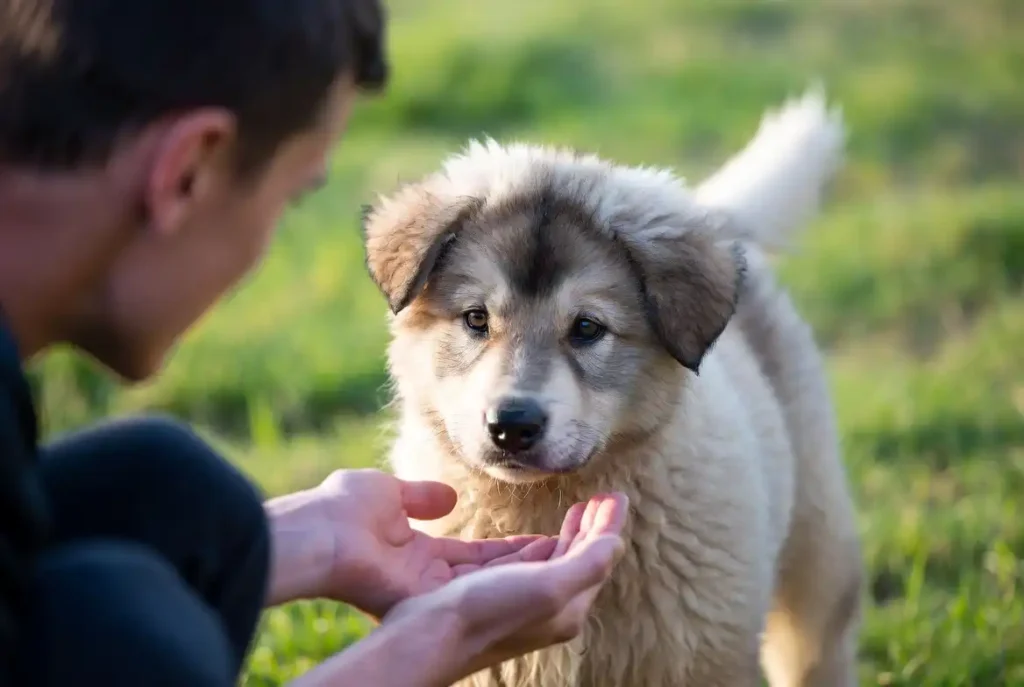
People exposure. This is the single highest priority during these two weeks. The key difference from companion breed socialization: never force your Anatolian to approach anyone. Let the puppy decide when to close the distance. For this breed, watching a stranger from six feet away while eating a piece of chicken is a successful socialization event. A companion breed puppy might need to be licking the stranger’s face for it to “count.” An Anatolian needs to process the stranger calmly and voluntarily disengage. That’s the win.
Sound and environment exposure. Play recordings of traffic, thunder, construction, and fireworks at low volume during calm moments — increase volume gradually over days. For rural or working homes: farm equipment sounds, livestock vocalizations, and vehicle sounds from the driveway. Introduce different floor surfaces in your house: tile, carpet, wood, a wobble board, a cookie sheet. Stairs if you have them. The crate. Rain, wind, different temperatures — especially for a breed that may live or work outdoors.
Animal exposure. Introduce other calm, vaccinated dogs of different sizes. Puppy-safe cats. If you have livestock, supervised visual exposure through a fence — never unsupervised contact at this stage. Same-sex dynamics in Anatolians can develop early; if you have another dog, watch closely for resource guarding and space tension even at this age.
Weeks 10–12: Expanding the World
Now you’re introducing controlled challenges — mild novelty that stretches the puppy just past comfortable. A new environment they haven’t seen. A person wearing a hat or carrying an umbrella. A gentle dog that plays differently than the ones at home. The goal is slight discomfort followed by voluntary recovery. Not overwhelm.
⚠️ Flooding an Anatolian Puppy — Why Overwhelming Exposure Does the Opposite of What You Intend
Flooding means exposing the puppy to an overwhelming amount of stimulation in the hope that they’ll “get used to it.” With a companion breed, this sometimes works (though it’s still not recommended). With an Anatolian, flooding almost always backfires. Guardian breeds process the world through a threat-assessment lens. When you overwhelm that system, the puppy doesn’t learn “this is normal.” The puppy learns “the world is dangerous and I cannot escape.” That conclusion becomes the foundation for fear-based reactivity in adulthood — in a 130-pound dog. If your puppy tries to flee, freezes completely, or refuses food in a novel environment, you’ve gone too far. Remove them calmly. Try again tomorrow at lower intensity.
Handling socialization. This is critical and breed-specific. Your veterinarian, your groomer, and every person who will ever need to examine this dog needs you to build handling tolerance now. Touch feet daily. Open the mouth gently. Look in ears. Run your hands along the belly. Hold the paw and clip one nail (even if it doesn’t need it). Brush for 30 seconds. Run water over the feet. Pair every handling moment with high-value rewards. At 12 weeks, this is mildly annoying to the puppy. At 12 months, this is a battle you cannot win through force — you can only win through trust built now.
Child interaction. Always supervised. Always. Teach the children first: no running at the dog, no grabbing, no squealing, no hugging. Let the puppy approach children on their own terms. An Anatolian puppy who learns that children are calm, predictable, and associated with treats will become an adult who is watchful over children rather than wary of them. But this breed’s size alone — even at 4 months — makes unsupervised child-dog interaction a safety risk regardless of temperament.
Weeks 12–16: Reinforcing and Deepening
The window is narrowing. You’ll feel it. Exposures that would have been easy at Week 9 now take more patience at Week 13. The puppy may show hesitation toward things they previously accepted. This is normal. Don’t push harder — push more creatively. Switch to new locations: hardware stores, outdoor café patios, different neighborhoods. Variety matters more than repetition now.
🔎 Fear Period Recognition — What It Looks Like in Anatolians
Fear imprint periods commonly appear at 8–10 weeks and again at 6–14 months. During a fear period, a puppy may suddenly react to something they were fine with yesterday — a hat, a sound, a person. In Anatolians, this looks different than in companion breeds:
What you’ll see: Refusal to approach familiar things. Sudden barking or growling at objects. Planting and refusing to walk forward. Hackles up in a previously comfortable environment. Intense staring without the usual curiosity.
What to do: Don’t force exposure. Don’t comfort excessively (this can validate the fear). Calmly redirect. Try again at lower intensity the next day. Keep sessions short. Let the puppy recover.
What makes it worse: Punishment. Flooding. Dragging the puppy toward the feared object. Laughing it off and pushing through. Any negative experience during a fear period can imprint permanently — especially in a breed already primed for wariness.
Start building the “default check-in” behavior: when your puppy encounters something new and looks back at you, reward that look. Heavily. An Anatolian that checks in with their owner during novel situations is infinitely safer and more manageable as an adult. You’re not suppressing their instinct to assess — you’re adding a step where they consult you before acting on it.
4–6 Months: The Adolescent Approach
After watching multiple Anatolians go through this stage, the pattern is clear: somewhere around 4–5 months, the puppy who seemed reasonably social starts acting like a different dog. More reactive on walks. More suspicious of visitors. Less interested in your training treats. This is the independence surge — the guardian programming coming online in earnest.
This is not your socialization failing. This is the breed emerging. Your job now shifts from volume-based exposure (meet as many things as possible) to maintenance-based exposure (keep existing tolerances from deteriorating). Continue introducing the puppy to new environments, but expect more processing time and less instant comfort. The Anatolian adolescent brain is rewiring itself for adult guardian function, and your earlier work is not lost — it’s being integrated into a more complex behavioral framework.
“The goal of socializing an Anatolian is not to make them friendly with everyone. It is to make them wise enough to know the difference.”
The Specific Challenges Unique to This Breed
Socializing Around Their Territory
The same puppy who was calm and collected meeting strangers at the park may react completely differently when someone approaches your front gate. This isn’t inconsistency — it’s context-dependent guardian behavior. Territory amplifies everything. The behavior that looks like socialization failure is often actually the dog distinguishing between neutral ground and home ground, which is precisely what guardian breeds are supposed to do.
The property walk ritual helps: when a new person arrives, bring the dog out to meet them at a neutral point away from the property boundary, walk together toward the home, and enter together. This tells the dog’s territorial brain: “this person entered with us, not against us.”
The Visitor Introduction Protocol for Anatolian Homes
Step 1: Alert and Contain
When you know a visitor is coming, put the dog on a leash or behind a gate before they arrive. Never let an Anatolian greet someone at the door uncontrolled.
Step 2: Parallel Introduction
Meet the visitor outside, away from the property boundary if possible. Have the visitor stand still and sideways. Let the dog observe from a distance.
Step 3: Walk Together
Walk the dog and visitor side by side (not face to face) toward the home. Movement together signals companionship, not intrusion.
Step 4: Enter Together
Bring the visitor into the home with the dog present but managed. Visitor should ignore the dog initially. No direct eye contact, no reaching out.
Step 5: Let the Dog Approach
Once the dog settles, they may approach the visitor on their own. Visitor can offer a treat with a flat hand, low and to the side. If the dog doesn’t approach — that’s fine. Tolerance of presence is success with this breed.
Socializing with Other Dogs
Dog parks are not appropriate for most Anatolians. Full stop. The combination of unfamiliar dogs, enclosed space, high energy, and unpredictable behavior is a recipe for exactly the kind of confrontation guardian breeds handle with escalation, not play bows. Same-sex aggression is common in this breed, especially from adolescence onward. On-leash introductions to calm, known dogs in open spaces are vastly more productive than off-leash free-for-alls.
Children and Anatolians
Supervision is non-negotiable, always, regardless of how well socialized the dog is. An Anatolian that adores your children can still accidentally knock a toddler flat — these are not physically aware dogs in tight spaces. Build genuine affection, not mere tolerance, by pairing calm child presence with the dog’s favorite experiences. But never, ever confuse the Anatolian’s patience with safety. For more on behaviors to watch for as your dog matures, refer to common Anatolian Shepherd behavior problems and how to solve them.
Livestock and Working Context
For owners with farm animals: livestock socialization is a separate process from human and dog socialization, with its own rules and timeline. A puppy pen adjacent to but separated from livestock (visual and olfactory exposure without direct contact) is the starting point. Direct supervised contact begins only after the puppy demonstrates calm, non-predatory interest. This is a deep topic on its own — the key principle for now is that livestock bonding and human socialization can happen simultaneously, but they require different protocols.
Why Standard Puppy Advice Doesn’t Apply Here
| Socialization Element | Companion Breed Approach | Anatolian Shepherd Approach | Why It Differs |
|---|---|---|---|
| Stranger greeting | Encourage approach and physical interaction | Let puppy observe from distance; approach only if voluntary | Forced greeting builds anxiety, not confidence, in a wary breed |
| Dog parks | Regular visits for off-leash play | Avoid entirely; use controlled, one-on-one dog introductions | Unpredictable enclosed spaces trigger defensive responses in guardian breeds |
| Success metric | Dog is friendly, wiggly, eager to interact | Dog is calm, observant, non-reactive, checks in with owner | A “friendly” Anatolian has likely been over-socialized for its breed function |
| Puppy class format | Free play with all dogs in the class | Structured class with trainer aware of LGD needs; limited or managed play | Free play with pushy puppies teaches Anatolians that other dogs are threats to be managed |
| Window urgency | Flexible through 16+ weeks | Compresses; wariness consolidation by 12–13 weeks | Fear responses mature earlier in guardian breeds |
What Not to Do — Mistakes That Set Anatolians Back
✅ What Experienced LGD Owners Do
Let the puppy set the pace of every interaction
Expose the puppy to 100+ people in the first 4 weeks — mostly passive exposure
Use high-value rewards paired with every new experience
Build handling tolerance daily at young ages (feet, ears, mouth)
Provide decompression time after every intense socialization session
Find a trainer who understands LGD breeds specifically
Continue socialization maintenance through adolescence and beyond
❌ What Creates Long-Term Problems
Isolating the puppy during the socialization window “to keep them safe”
Forcing interaction when the puppy shows avoidance or retreat
Flooding: taking the puppy to a crowded festival and hoping they “get over it”
Punishing fearful responses — growling, backing away, hackles up — as disobedience
Using puppy classes designed for companion breeds without modifications
Stopping socialization after the puppy seems “fine” at 14 weeks
Socializing without decompression — back-to-back overwhelming experiences
The cases that concern me most are the ones where a well-meaning owner over-relies on a puppy class taught by a trainer whose experience is entirely with herding dogs and retrievers. These trainers often encourage approaches — “just let him say hi!” — that directly conflict with how an Anatolian processes social information. Look for a trainer who understands livestock guardian breeds or, at minimum, one who is willing to learn. The International Association of Animal Behavior Consultants can help you find qualified professionals who work with complex breed profiles.
When Socialization Gets Complicated
The Rescue or Rehomed Anatolian
If you’ve adopted an Anatolian past the primary socialization window — and many rescue Anatolians arrive at 6 months or older with minimal socialization — you need to reset your expectations. A dog whose window has closed cannot be “re-socialized” in the way a puppy can. You can build tolerance, management protocols, and careful positive associations. But the adult Anatolian who was unsocialized as a puppy will likely never be the dog who calmly sits in a café while strangers walk by. Make peace with this early. It protects both of you.
Fear Responses That Appear at 6–8 Months
The secondary fear period hits Anatolians hard. A puppy who was tolerating strangers at 12 weeks may suddenly bark at the FedEx driver at 7 months. This is not your earlier work unraveling — it’s a normal developmental stage where the adolescent brain re-evaluates what it has catalogued. Continue controlled exposure. Don’t escalate. Don’t punish. This period passes, but if you react badly to it, the fear can consolidate permanently.
Aggression vs. Appropriate Guardian Behavior
The line matters, and misreading it in either direction is dangerous. Appropriate guardian behavior: barking to alert, positioning between a stranger and the family, standing tall and still while assessing. Problematic behavior: lunging without provocation, biting without warning signals, inability to de-escalate after the threat is clearly gone, redirecting aggression onto family members.
If you are seeing true aggression — unpredictable, escalating, or directed at family — involve a veterinary behaviorist certified through the American College of Veterinary Behaviorists. Not a general trainer. Not an online forum. A professional who can assess whether this is a socialization gap, a neurological issue, or a pain response.
In my experience working with large guardian breeds, the owners who struggle most are not the ones who did nothing — they are the ones who did the wrong things with the best intentions during a window that doesn’t reopen.
Training That Supports Socialization
Obedience training and socialization are not separate projects. Every positive training interaction during the socialization window strengthens the bond, builds the puppy’s confidence in you as a decision-making partner, and gives you tools for managing the exact situations socialization puts you in.
Name recognition comes first. Before anything else, this puppy needs to snap their head toward you when they hear their name — because in six months, you will need that head-turn to redirect them away from something their guardian brain has decided to investigate.
“Come” is the recall that could save their life. Practice in low-distraction environments first, always with high-value rewards. An Anatolian’s recall will never be Labrador-reliable — accept this — but a recall that works 80% of the time in your yard is the difference between an incident and a close call.
“Leave it” redirects guardian responses. When the puppy fixates on a jogger, a squirrel, or a visitor — “leave it” paired with a reward teaches the puppy that disengagement has value.
“Place” or “go to mat” is your visitor management tool. Teaching the puppy to go to a designated spot and stay there gives them a job during situations that would otherwise trigger territorial behavior.
What motivates Anatolians? Not always food, and rarely what motivates a retriever. Many Anatolians are less food-driven than companion breeds, especially when aroused or in novel environments. Experiment with high-value options: real meat, cheese, liver treats. Some Anatolians respond better to verbal praise, physical proximity, or simply being given space after compliance. The independent thinker problem — where an Anatolian seems to “forget” a command they knew perfectly yesterday — is not forgetfulness. It’s the dog weighing whether compliance serves their current assessment of the situation. Train for reliability by making compliance consistently more rewarding than the alternative.
📋 Weekly Socialization Tracker — Simple Framework
Track these five categories each week. Aim for at least 3–4 new exposures per category per week during the primary window (8–16 weeks):
👤 People: ___/week (different ages, genders, appearances, accessories — hats, sunglasses, uniforms)
🔊 Sounds: ___/week (household, traffic, weather, farm equipment, recorded sounds)
🌍 Environments: ___/week (new surfaces, new buildings, new outdoor spaces, vehicles)
🐕 Animals: ___/week (dogs of different sizes, cats, livestock if applicable)
✋ Handling: ___/week (feet, ears, mouth, belly, brush, nail touch, bath, vet-style exam)
Owner Case Notes
Case Note 1: The Suburban First-Timer
Rachel brought home her first Anatolian, Atlas, at 8 weeks — to a suburban neighborhood with no livestock. She found a trainer who had worked with Kangals and started a structured socialization program immediately. She carried Atlas through a farmer’s market at Week 9. Had 12 different friends visit the house in the first 10 days. Walked him through two new neighborhoods every week. Played recorded thunderstorms while he ate dinner. Touched his feet every single day. Kept a log.
At Week 14, a neighbor walked into Rachel’s unfenced yard unannounced. Atlas, now 35 pounds, stood up from where he was lying on the porch. He didn’t rush the fence. He didn’t bark. He stood, watched, and then turned his head to look at Rachel. She told him “it’s okay,” and he sat back down, still watching. That check-in — that moment of consulting his owner before acting — was the product of six weeks of patient, breed-appropriate socialization. Her neighbor’s unsocialized German Shepherd, by contrast, had gone through the screen door the month before.
Case Note 2: The Farm Owner Who Waited
David got his Anatolian, Koda, from a working line. The breeder recommended minimal human interaction to keep the puppy “bonded to livestock.” The vet recommended waiting until full vaccination to take the puppy anywhere. Between those two well-meaning recommendations, Koda was 14 weeks old before David started any real socialization with people outside his immediate family.
By 14 weeks, Koda’s wariness was already consolidated. He wouldn’t approach unfamiliar adults. He barked at hats. He needed 20 minutes to settle when a vehicle came up the driveway. David adjusted: smaller exposures, longer timelines, more distance, fewer expectations. He worked with a behaviorist who understood LGDs. Over the next six months, Koda became a functional, manageable working dog — reliable with David’s family, excellent with his goat herd, predictable enough for the veterinarian to handle with precautions.
But Koda will never be comfortable with strangers. David makes peace with that. He manages visitors, warns delivery drivers, keeps Koda contained when unfamiliar people come onto the property. Koda is outstanding at his job. He’s safe. He’s loved. But David will tell you plainly: if he could go back and start socialization at 8 weeks, knowing what he knows now, he would. The window was real, and the six weeks he lost shaped the dog permanently.
“Raising an Anatolian taught me that patience is not waiting for the dog to do what you want. Patience is standing still while the dog decides, on its own timeline, that the world you’ve introduced it to is safe enough to share.”
Frequently Asked Questions
My Anatolian puppy is already 14 weeks — have I missed the socialization window completely?
Not completely, but you’ve lost the easiest part. The primary window is closing or closed by 14 weeks in most Anatolians. Start immediately with low-pressure, high-reward exposures. You can still build meaningful tolerance and management skills, but expect progress to be slower and the ceiling to be lower than if you had started at 8 weeks. Every day you wait from here makes it harder — so start today.
How do I socialize my Anatolian puppy before they are fully vaccinated without putting them at disease risk?
Use carry socialization: hold the puppy in public spaces so they can observe without contacting the ground. Invite vaccinated, healthy dogs to your home. Have friends visit — different people, multiple times per week. Avoid high dog-traffic areas like dog parks, pet stores with heavy foot traffic, and sidewalks near vet clinics. Use clean outdoor surfaces like your driveway or a friend’s fenced yard. Talk to your vet about the specific disease risk in your area versus the behavioral risk of delayed socialization.
My puppy was friendly at 9 weeks but now seems fearful of strangers at 4 months — what happened?
Welcome to the guardian instinct coming online. Between 3–6 months, Anatolians undergo a natural shift toward wariness as their breed-specific programming matures. This is not a failure of your socialization — it’s the breed doing what it does. Continue controlled, positive exposures. Don’t force interactions. The socialization you did earlier is still there — the puppy is now integrating it into a more complex adult behavioral framework.
How do I know if my Anatolian’s wariness around strangers is normal guardian behavior or a socialization problem?
Normal guardian wariness looks like: calm observation, standing still, positioning between you and the stranger, barking to alert, settling after you acknowledge the person. A socialization problem looks like: panic, unprovoked lunging, inability to calm down even after the stranger has been accepted by you, aggression toward known visitors, or fear responses in familiar environments. The first is the breed working. The second needs professional help.
Can I take my Anatolian puppy to a regular dog park or puppy class for socialization?
Dog parks: no, for most Anatolians. The enclosed, chaotic environment triggers defensive responses rather than social learning. Puppy classes: yes, but choose carefully. Look for structured classes with a trainer who has experience with guardian breeds or at least understands that not all puppies need to “play with everyone.” Avoid classes where free-for-all play is the primary socialization method. Your Anatolian needs controlled, calm interactions — not a mosh pit of puppies.
My Anatolian was socialized well as a puppy but is becoming more territorial as an adult — is that normal?
Yes. Increasing territoriality between 1–3 years is the normal maturation pattern for this breed. Your socialization didn’t fail — it set the foundation that keeps this natural territorial behavior within manageable bounds. A well-socialized territorial Anatolian can be managed safely. A poorly socialized territorial Anatolian is a liability. Continue visitor protocols, maintain controlled exposure, and appreciate that the socialization you invested in is the reason this phase is manageable rather than dangerous.
How do I introduce my Anatolian puppy to the livestock they will eventually guard without triggering prey drive?
Start with a puppy pen adjacent to, but separated from, livestock — visual and olfactory exposure only. Supervised visual contact before any physical access. When direct contact begins, keep sessions short and always supervised. Watch for play behavior (mouthing, chasing) — these are normal puppy impulses but must be interrupted immediately and consistently. Never leave a puppy under 6 months alone with small livestock. Even a playful puppy at 40 pounds can injure a lamb. An adult LGD mentor in the pasture, if available, dramatically accelerates appropriate behavior learning.
The Work That Builds the Dog
If you’re reading this at 11 p.m. with a puppy who just spent ten minutes staring at the back fence instead of coming inside when you called — you’re in the right place. You’re doing the right thing. And the fact that this feels harder than anything you’ve read about other breeds is not a sign that something is wrong. It’s a sign that you chose a breed that asks more of you precisely because it is capable of more.
Socializing an Anatolian correctly is harder than socializing most dogs. That’s the honest truth. The window is shorter. The margin for error is narrower. The puppy’s brain is wired to resist the very process you’re implementing. And the result — when done well — is one of the most remarkable working relationships in dog ownership. A dog that assesses, consults, and decides. A dog that lets the mail carrier pass but blocks the stranger who came over the fence. A dog that sleeps with one eye open not because it’s anxious, but because that’s the job it was born to do.
Every correct exposure. Every patient introduction. Every moment you stood still in the driveway letting the puppy process a new person instead of forcing a greeting — those moments are building the adult dog. The one who will one day make a judgment call you’ll be grateful for.
For deeper guidance on this breed’s unique personality and challenges, explore more Anatolian Shepherd care and training guides on AnatolianShepherd.me.
The dog watching the tree line right now? The one who checked on you twice in the last hour without being asked? That’s not stubbornness. That’s not a training failure. That’s six thousand years of breeding doing exactly what it was designed to do. Your job is to give that instinct the context it needs to serve you both. And you’re already doing it.
Written by: J. Harlan Reed, Large Guardian Breed Content Writer at AnatolianShepherd.me
Experienced Anatolian Shepherd owner with hands-on knowledge of guardian dog behavior, training challenges, and breed-specific care. Content reviewed using trusted veterinary and behavioral references alongside real owner experience for accuracy and reliability.
Disclaimer: This article is for educational purposes only and does not replace advice from a certified veterinary behaviorist or professional trainer with LGD experience. Individual dogs vary significantly based on genetics, early environment, and breeding line. Always consult qualified professionals for serious behavioral concerns.