Anatolian Shepherd Shedding Season Tips: The Complete Owner’s Guide for 2026
Updated for 2026 · Breed-specific guidance grounded in veterinary dermatology research and hands-on grooming experience.
1. The First Shedding Season Nobody Warned You About
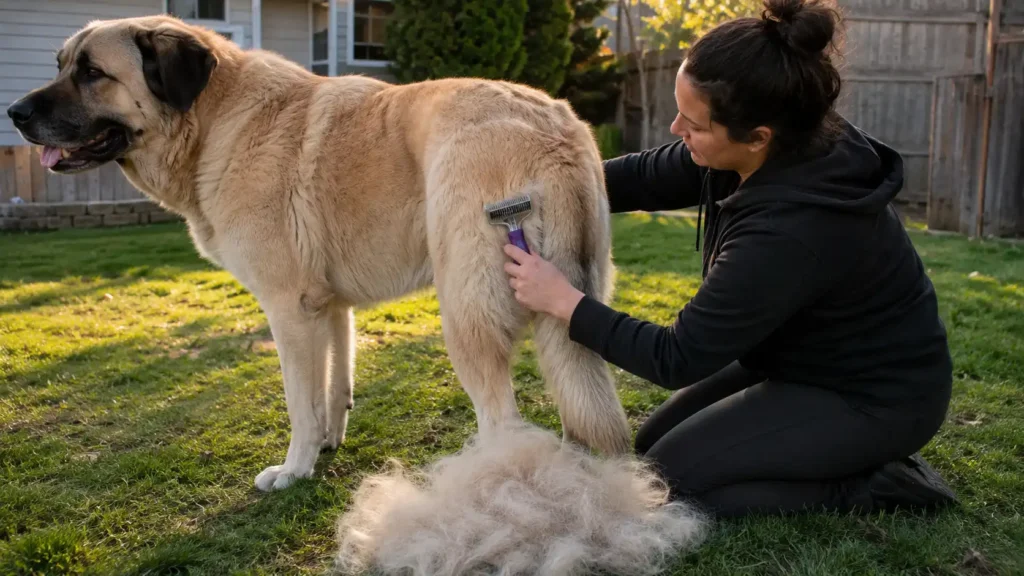
It is a Saturday in late March. Your Anatolian is lying on her side in the backyard, the first real warm sun of the year on her flank. You run a brush down her shoulder out of habit, the way you have for ten months without much happening, and a clump of pale undercoat the size of a dinner roll comes off in one pass.
You do it again. Another clump. You sit down because something is clearly happening here that you did not sign up for, and forty minutes later there is a grocery bag of undercoat next to you and your dog has not visibly changed shape.
That is week one. There are five more weeks coming.
This is not a bad shedding day. This is the spring blowout, and if you have never owned a working double-coated breed before, nothing you have read about “heavy shedders” has prepared you for the actual physical volume of coat an Anatolian sheds in a six-to-eight-week window.
What makes Anatolian shedding sit in a different category from most double-coated breeds is the combination of three things at once: the density of the undercoat, the length and stiffness of the guard hairs, and the sheer body surface area of a 100-to-140-pound dog. This coat evolved on the Anatolian plateau to survive winters that drop well below freezing and summers that crack the soil. It did not evolve for a 2,400-square-foot suburban house with central heating, light-colored furniture, and a labrador-sized vacuum.
This guide gives you the biology behind why this is happening, the calendar of when to expect what, the tools that actually move this coat (and the ones that do not), the technique that removes the most undercoat in the least time, the health signals hidden inside the shedding pattern, and the home management reality that keeps the situation livable.
In my years working with Anatolian Shepherd owners, the single moment that separates prepared owners from overwhelmed ones is not the first shedding season — it is whether they understood what was actually happening before it started.
2. The Coat Biology — Why Anatolians Shed the Way They Do
The Double Coat Architecture
An Anatolian has two distinct coat layers growing out of the same follicle complexes — and they do not behave the same way.
The guard hair layer is the outer coat. These are the longer, coarser hairs you see on the surface — weather-resistant, UV-protective, and structurally stiff. In the rough-coated variant they reach four inches or more around the neck and ruff. In the smooth-coated variant they sit closer to the body. Guard hairs shed in low volume continuously throughout the year. They are not the hair filling your house in April.
The undercoat is the layer doing the dramatic work. It is a dense mass of secondary hairs — fine, soft, and crimped — that grow from the same follicles as the guard hairs but cycle on a completely different schedule. The undercoat is the dog’s thermal regulation system. It traps insulating air in winter and, when it is shed correctly, opens up the skin to airflow for summer cooling. This is the layer that releases in massive synchronized waves twice a year.
The structural difference matters: guard hairs are anchored deep with thick keratinized shafts. Undercoat hairs are shorter, finer, and held loosely once they enter the resting phase. That is why a brush passed across a shedding Anatolian extracts handfuls of soft undercoat while the coarse guard layer stays largely in place — and why grooming this breed is fundamentally about reaching past the guard coat to clear the layer underneath.
Coat variant matters too. Rough-coated Anatolians have a more visible guard layer and longer feathering on the legs and tail; the dense undercoat underneath is similar in volume to the smooth variant but harder to access and more prone to matting at the friction points. Smooth-coated Anatolians show their shedding more visibly on the dog’s surface but are slightly easier to brush through. The total shed volume across both variants is comparable. The management is what differs.
The Photoperiod Trigger — The Science Most Owners Never Hear
Here is what almost no grooming article tells new owners: the spring blowout is not triggered by warm weather. It is triggered by changing day length.
The mechanism is photoperiod-driven. The pineal gland detects increasing daylight hours through retinal input, melatonin secretion drops in response, and that hormonal shift signals the hair follicles across the body to push their undercoat into the telogen (resting) phase more or less simultaneously. Once in telogen, the hairs detach from their follicular anchor and the entire coat releases in a wave over the following weeks.
This is why the spring blowout begins on a relatively predictable calendar in temperate latitudes regardless of whether the weather has actually warmed. A late-snow March will not delay it. An unusually warm February will not accelerate it. The light is the signal.
The 2023 dermatology research from the UC Davis School of Veterinary Medicine on photoperiod-mediated coat cycling in double-coated breeds confirmed something experienced groomers had long suspected: indoor dogs exposed to artificial light past sunset show measurably disrupted shedding cycles compared to dogs living primarily outdoors. The artificial light extends perceived day length, which can produce partial blowouts, extended shedding windows of three to four months instead of six to eight weeks, and irregular timing year over year.
This is the answer to one of the most common questions I hear from new Anatolian owners: why is my dog shedding in January? Why is the shedding dragging on into June? Why did last year’s blowout look nothing like this year’s? The answer is almost always artificial photoperiod disruption.
The climate variable matters too. Owners in southern latitudes — Texas, Florida, southern California — see blowouts that start earlier and run longer because the photoperiod gradient through the year is shallower. Owners in northern latitudes see sharper, more compressed blowouts. The “spring and fall” generalization that gets repeated in breed articles is only accurate for temperate-zone dogs at roughly 35–50° latitude. UC Davis Veterinary Medicine’s dermatology resources cover the underlying coat biology in more depth for owners who want to understand what their dog’s specific environment is doing to the cycle.
Pro Tip — The Photoperiod Insight
If your Anatolian sleeps in a room with a TV on past 10 p.m., or a hallway light visible from her bed, you are subtly extending her perceived day length year-round. Owners who shift their dog’s sleeping area to a darker room or use blackout curtains often see the next year’s spring blowout become noticeably sharper and shorter — six weeks of intense shedding instead of fourteen weeks of dragging release. You cannot replicate the Anatolian plateau, but you can give the pineal gland a cleaner signal.
The Anatolian Coat in Historical Climate Context
To understand why this coat behaves the way it does, you have to understand the climate it was built for. The Anatolian plateau is continental — winter lows below -20°C are common, summer highs above 35°C are routine, humidity stays relatively low year-round, and the seasonal transitions are sharp rather than gradual.
A coat that survives those conditions has to do four things: insulate against deep cold, shed completely enough each spring to allow summer heat dissipation, repel UV through dense guard hair pigmentation, and dry quickly when wet to prevent skin issues. Research from Ankara University and Selçuk University veterinary faculties documenting working Kangal and Anatolian populations has found that dogs in their native climate tend to show sharper, more compressed shedding cycles and fewer chronic skin conditions than transplanted populations in humid or temperate environments.
What the Turkish veterinary research shows — and what almost never makes it into English-language grooming articles — is that the dense undercoat in humid climates retains moisture significantly longer than in dry continental conditions. That moisture retention is the reason hot spots, folliculitis, and yeast overgrowth are more common in American Anatolians than in working Turkish populations. The coat itself has not changed. The environment around it has.
For owners in humid regions, this translates into a single practical rule: more frequent grooming during shedding season is not optional, because trapped undercoat in humidity is a skin problem waiting to develop.
3. Shedding Season Timing — What to Expect and When
| Period | Timing | Intensity | Primary Action | Duration |
|---|---|---|---|---|
| Winter Maintenance | Dec – early Feb | Background | Weekly brush, mat checks | 10–12 weeks |
| Pre-Blowout Loosening | Mid Feb – early Mar | Moderate | Increase to 2–3 sessions/week | 2–3 weeks |
| Spring Blowout (Peak) | Mid Mar – late Apr | Full Blowout | Daily rake + weekly deep session | 4–6 weeks |
| Spring Tail-Off | Early – mid May | Moderate | 3 sessions/week, finish lines | 2 weeks |
| Summer Maintenance | Jun – Aug | Background | Weekly check, hot-spot watch | 12 weeks |
| Fall Blowout | Sep – Nov | Moderate | 2–3 sessions/week | 3–5 weeks |
The Primary Spring Blowout
For most Anatolians in temperate northern latitudes, the spring blowout begins between mid-February and mid-March and runs four to eight weeks. Indoor dogs with disrupted photoperiod commonly run longer — eight to twelve weeks is not unusual.
The volume is genuinely extraordinary. A first-time owner should expect to remove enough undercoat in a single peak-week session to fill a kitchen trash bag. Across the full blowout, three to four large bags from one dog is normal. The peak density usually falls in weeks two through four, when the coat is releasing fastest and daily brushing is most productive.
You will know the blowout is ending when sessions start producing meaningfully less material — when a thirty-minute rake session yields a softball of undercoat instead of a pillow’s worth. The guard coat will look tighter and flatter against the body. Skin will be more easily visible when you part the coat at the haunch.
The Fall Blowout
The fall blowout runs September through November and is shorter and less dramatic — typically three to five weeks. The reason is structural: the coat coming in for winter is denser than the coat going out, so the dog is shedding the lighter summer undercoat to make room for the heavier winter one. There is simply less material to release.
Fall grooming requires a slightly different priority. Spring grooming is about volume removal. Fall grooming is about preventing the new winter undercoat from coming in tangled with retained summer hair — the layered matting that creates the worst mid-winter coat problems. Sectioning carefully and clearing thoroughly in fall pays off in February.
Continuous Background Shedding
Between the blowouts, Anatolians shed at a low continuous level. A weekly brushing session that produces a tennis ball of hair is normal. The dog should not be visibly losing density. Skin should be fully covered and not visible without parting the coat.
What distinguishes normal background shedding from a problem is the pattern. Even, distributed, low-volume release is healthy. Patchy thinning, sudden volume increases outside seasonal timing, or shedding accompanied by skin changes are not.
Abnormal Shedding Patterns — When to Notice
Patchy shedding — distinct bald or thinning areas — is almost never normal seasonal behavior. It points to localized issues: contact allergy, parasitic infection, fungal involvement, or focal endocrine response. Even whole-coat release is the seasonal pattern; selective patchy release is a diagnostic flag.
Excessive shedding with skin changes — redness, scaling, odor, thickening, or pigmentation shifts — warrants a vet visit. Hypothyroidism in particular shows a recognizable pattern in Anatolians: symmetric thinning along the flanks and tail, dull dry coat texture, slow regrowth, and weight gain. Cushing’s disease produces thinning with a thin, fragile skin presentation. Nutritional deficiency typically shows as brittle, dry coat with poor undercoat density.
The 2024 research published in the Journal of Veterinary Dermatology on stress-induced coat changes in large working breeds documented something useful for Anatolian owners specifically: chronic cortisol elevation from environmental stressors (kennel transitions, household conflict, new household members) can produce telogen effluvium — a synchronized shedding event two to three months after the stress trigger that mimics a seasonal blowout but happens off-cycle. If your Anatolian is shedding heavily in July with no skin changes and no other symptoms, think back to what happened in April or May.
| What You Observe | Possible Cause | Action Required | Urgency |
|---|---|---|---|
| Symmetric thinning on flanks, dull coat, weight gain | Hypothyroidism | Thyroid panel bloodwork | Vet appointment |
| Distinct round bald patch, possibly scaly | Ringworm or focal infection | Vet exam, fungal culture | Vet appointment |
| Wet, red, foul-smelling area appearing in 24 hrs | Hot spot (acute moist dermatitis) | Trim coat around it, vet within 48 hrs | Prompt vet visit |
| Brittle undercoat that breaks rather than releases | Possible nutritional deficiency | Diet review, possible bloodwork | Vet appointment |
| Heavy shedding outside seasonal window, no skin issues | Telogen effluvium from prior stress | Monitor 4–6 weeks, vet if persistent | Monitor |
| Pustules, crusts, foul odor on skin | Bacterial folliculitis or pyoderma | Vet exam, likely antibiotics | Prompt vet visit |
| Slight increase in background shedding in summer | Normal heat-response variation | Continue weekly grooming | Monitor |
4. The Tools That Actually Work for Anatolian Coat
After trying most of the major undercoat tools on actual Anatolian coat, I can tell you that the marketing on grooming equipment rarely matches what the tool does on a 130-pound double-coated working breed. Here is what each tool actually does, what it does not do, and when to reach for it.
The Undercoat Rake
This is the single most important tool you will own. An undercoat rake is a long-tined comb — usually rotating or fixed — designed to slide through the guard coat and grab loose undercoat without cutting either layer.
For an Anatolian, look for a rake with tines at least 1.5 inches long, rounded tips (sharp tips abrade skin on a dog this large), wide tine spacing to prevent clogging in dense coat, and a substantial handle — sessions can run thirty to ninety minutes during peak blowout, and a thin handle becomes painful in your wrist within the first week. Rotating-tine rakes (sometimes called “rotating undercoat rakes”) work better on Anatolian density than fixed-tine versions because the rotation prevents the tines from yanking attached hairs when they meet resistance.
Technique matters as much as the tool. Rake in the direction of hair growth, not against it. Use moderate pressure — the weight of the tool itself plus a light additional press, not a scrape. Work in small sections, roughly the size of your palm. Pulling a rake hard across a large area is how owners cause skin abrasion and stop their dogs from tolerating grooming sessions.
What rakes do not do: they do not solve mats. A mat needs to be split with a mat splitter or worked apart with a comb before any rake is used in that area. Trying to rake through a mat tears it from the skin and is genuinely painful for the dog.
The Slicker Brush
A slicker brush has fine, bent wire bristles set in a flat or curved pad. On an Anatolian, the slicker is a finishing tool, not a primary undercoat removal tool. Use it after the rake has done its work to lift remaining surface debris, smooth the guard coat, and catch the last loose undercoat at the surface.
The sequencing matters. Slicker before rake just pushes loose undercoat deeper into the coat and creates surface mats. Rake first, slicker second, every time.
For rough-coated Anatolians, a long-pin pin brush is sometimes a better finisher than a slicker — the longer pins reach the longer guard hairs without the slicker’s tendency to snag on coarser outer coat.
The Deshedding Tool (Furminator-Type Bladed Tools)
This is the controversial tool. Bladed deshedding tools have a fine-toothed metal blade that catches and pulls loose undercoat very efficiently — but the blade also cuts. On a single-coated dog or a dog with minimal undercoat, this is fine. On a double-coated working breed, repeatedly using a bladed tool risks cutting and weakening the guard coat, which compromises the coat’s weather and UV protection.
The honest position: a bladed deshedding tool used occasionally on the body — once or twice across a full blowout, never on the same area in consecutive sessions — can pull serious volume in a short window. Used as a primary tool every grooming session for weeks on end, it gradually thins and dulls the guard coat in ways that take a year or more to recover from.
Many Anatolian owners don’t realize until their second shedding season that the slightly shorter, slightly duller-looking guard coat they noticed in fall was the cumulative result of over-using a bladed tool through spring.
High-Velocity Dryer
This is the single most efficient undercoat removal tool that most home owners do not own. A high-velocity dryer (HV dryer, force dryer) blows air at 50,000 to 70,000 feet per minute, which physically lifts and ejects loose undercoat from the coat structure faster than any brush can.
One thirty-minute session with an HV dryer can remove what three hours of brushing produces. The technique: use it on a clean dry coat, hold the nozzle four to six inches from the body, work in the direction of hair growth, and section the dog the same way you would with a rake.
The investment question: a quality HV dryer runs $200–$450. For one Anatolian over the dog’s twelve-to-fourteen-year lifespan, the math works against the equipment cost — but only if you stay consistent. Most owners do not. A professional HV blowout session every three to four weeks during peak shedding ($60–$100 per session in most US markets in 2026) often makes more financial sense than the equipment.
The noise consideration is real. An HV dryer is loud — comparable to a leaf blower. A dog who has never heard one will not tolerate it the first time. Introducing the dryer requires the same desensitization approach used for vacuum introduction: introducing grooming tools and handling to Anatolian Shepherd puppies correctly from the first months pays off enormously when you bring a force dryer near them at age three.
The Grooming Table Question
For a 120-pound dog, a grooming table is a posture-saving device for the owner — not a luxury. Bending over a large dog on the floor for forty-five minutes will end your back. A heavy-duty large-breed grooming table with a non-slip surface and an adjustable arm puts the dog at waist height and lets you work without hunching.
That said, many Anatolians dislike being elevated and restrained. The alternative is a non-slip rubber mat in a garage or covered outdoor area, with the owner sitting on a low stool. This works, it just takes longer because you cannot reach all sides without the dog repositioning.
What Not to Buy
Avoid grooming gloves marketed for “all coat types.” On Anatolian density, the rubber nubs do not penetrate the guard coat enough to reach the undercoat — they catch surface debris and not much else. They are useful for short-coated breeds and not for this one.
Avoid wide-spaced single-row metal combs marketed as “undercoat combs.” On Anatolian coat, they slide through the guard layer without engaging the undercoat at all. A proper rake has dual-row or rotating tines for a reason.
Avoid any tool with a serrated cutting edge marketed as a “shed blade.” These cut undercoat and guard hairs indiscriminately and produce a shorter, fluffier-looking coat that owners often mistake for healthy reduction. It is damage.
| Tool | Purpose | Effectiveness | Best Used | Cautions |
|---|---|---|---|---|
| Undercoat rake (rotating, long-tine) | Bulk undercoat removal | Excellent | Primary tool, every session in blowout | Avoid mats; rounded tips only |
| High-velocity dryer | Lift and eject loose undercoat | Excellent | After bath, weekly in peak season | Loud; requires desensitization |
| Slicker brush | Surface finishing, loose hair lift | Moderate | After rake, never before | Light pressure; skin abrasion risk |
| Wide-tooth metal comb | Mat detection, finishing | Moderate | Pre-session check, behind ears, armpits | Not a primary undercoat tool |
| Bladed deshedding tool | Cut and remove loose undercoat | Use sparingly | 1–2 times per blowout, body only | Damages guard coat with overuse |
| Mat splitter | Break apart formed mats | Essential when needed | Before raking matted areas | Sharp blade — work slowly |
| Rubber grooming gloves | Surface hair, bath | Poor | Bath only, optional | Cannot reach Anatolian undercoat |
5. The Grooming Technique — The Session That Actually Works
Pre-Session Assessment
Before you pick up a tool, run your hands over the entire dog. You are doing two things: identifying where the undercoat is densest (almost always the neck, shoulders, haunches, and base of the tail), and finding any mat formation before you hit it with a rake.
The mat-prone areas on an Anatolian are predictable: behind the ears, under the collar line, in the armpits, in the inner thighs, and in the feathering at the back of the rear legs on rough-coated dogs. Check these every session. A mat caught at pea-size is a thirty-second fix; the same mat at golf-ball size is a twenty-minute extraction.
While you are assessing, look at the skin. Healthy Anatolian skin under dense coat is pale pink, occasionally with darker pigmentation, with no flaking, no redness, no greasy feel, and no odor. If you smell anything yeasty or musty as you part the coat, you have a developing skin issue that needs attention before any grooming.
The Dry vs. Damp Coat Question
Veterinary grooming science generally supports the observation that lightly dampened coat releases undercoat more efficiently than bone-dry coat. The mechanism is simple — slight moisture reduces the friction between guard hairs and undercoat fibers, and the fine undercoat hairs lift more cleanly.
The practical application: a light spray mist of plain water (or a diluted leave-in conditioner formulated for dogs) across each section before raking can meaningfully reduce session time. The coat should be barely damp, not wet. Wet coat invites raking damage and is harder to dry to the skin afterward.
Sectioning Technique
Sectioning matters more than new owners expect. The systematic approach removes more coat in less time and prevents the situation where you spend an hour and find an entire untouched chunk of undercoat on a side you thought you had finished.
Work the dog in this sequence: start at the rear haunch on one side, work forward to the shoulder, then up to the neck and ruff, then carefully around the head and ears, then down the chest, then the front leg, then move to the other side and repeat. Finish with the tail and the feathering. Do the belly with the dog standing if you can.
Section size should be roughly your palm width. Work each section thoroughly before moving — meaning rake until the section produces only a few hairs per pass, not just one or two passes per area.
The Shedding Season Grooming Session: Step-by-Step
- Set up. Non-slip mat or grooming table, rake, mat splitter, comb, slicker, water spray bottle, two trash bags (one for hair, one for waste), water for the dog.
- Assess (3–5 minutes). Hands over the entire dog, identify dense areas and check mat-prone spots. Note any skin changes for follow-up.
- Address mats first. Use the mat splitter and comb to work apart any tangles before any rake touches that area.
- Light mist. Spray each section just before working it. Coat should be slightly damp, not wet.
- Rake systematically. Start rear haunch, work forward. Palm-sized sections, rake until the section yields minimal hair per pass.
- Move and break. Every 15–20 minutes, let the dog stand, drink water, reposition. Anatolians do not tolerate prolonged restraint.
- Finish with the slicker or pin brush. Surface lift only — light pressure, smooth direction.
- Comb-check the whole dog. A wide-tooth comb should pass through cleanly. Anywhere it snags is an undercoat pocket you missed.
- Reward and end on a positive note. Treat, walk, release. The session needs to end with the dog feeling fine about it.
Session Length and Frequency During Shedding Season
For one person working alone with a 120-pound Anatolian, a realistic full session runs 45–75 minutes. Beyond that, both you and the dog are tired, technique gets sloppy, and the dog starts associating grooming with discomfort. During peak blowout, three sessions per week of 45 minutes each will outperform one weekly session of three hours, both in coat removal and in dog tolerance.
Anatolians signal session fatigue clearly: shifting weight repeatedly, turning the head to look at you, lip licking, yawning, and eventually trying to step off the mat or table. Stop before they escalate further — pushing past these signals is how grooming becomes a fight. Understanding how handling and grooming stress can affect Anatolian behavior during shedding season is part of why this breed needs gentle, predictable grooming routines from puppyhood onward.
For older dogs and dogs with joint concerns, position matters significantly. Avoid keeping the dog standing for the entire session. Allow lying on one side, work that side fully, then encourage rolling to the other side. Managing Anatolian Shepherd joint health during physically demanding grooming sessions becomes increasingly important after about age seven, and short sessions on a padded surface beat long sessions on hard floor every time.
The Bath During Shedding Season
A bath during peak blowout actually accelerates the shedding process — the warm water and shampoo loosen undercoat that is already in telogen, and a thorough rinse plus blowout can remove a remarkable volume in one session.
Use a shampoo formulated for double-coated breeds. Avoid heavy conditioning shampoos (they coat the guard hair and trap loose undercoat), avoid anything with strong fragrance (irritation risk), and avoid human shampoos entirely (pH mismatch). Oatmeal-based or basic dog shampoos with minimal added ingredients work well.
The rinse is the part most owners underdo. Shampoo residue trapped in dense undercoat causes itching, flaking, and sometimes secondary infection. Rinse until the water running off the dog is completely clear, then rinse for another minute. On an Anatolian this means ten to fifteen minutes of rinsing — significantly longer than feels necessary.
Drying matters more than bathing. An Anatolian must be dried to the skin, not surface dry. Trapped moisture in dense undercoat is the leading cause of hot spots in this breed during shedding season. A high-velocity dryer is the only practical way to dry an Anatolian to the skin in under an hour. Towel-and-air-dry leaves a damp pocket against the skin for six to twelve hours, and that is exactly the environment hot spots develop in.
6. Nutrition and Coat Health — The 2026 Research Update
Omega-3 Fatty Acids and Coat Quality
Studies published in the Journal of Animal Physiology and Animal Nutrition between 2022 and 2024 have looked at EPA and DHA supplementation effects on coat quality and shedding volume in large breeds. The findings are clearer than the marketing on fish oil products suggests.
Adequate omega-3 supplementation does not reduce seasonal shedding volume. Photoperiod-driven shedding is hormonal, not nutritional, and no amount of fish oil will shorten or lighten a spring blowout. What omega-3 supplementation does measurably affect is coat texture, guard hair integrity, and skin barrier function — meaning the coat that grows in is healthier and the skin underneath is less prone to inflammation, which supports cleaner shedding releases and faster recovery from any irritation.
The dosing reality for a large breed: “add fish oil” without a number is useless. Research-supported dosing for general skin and coat support in dogs is roughly 30–55 mg combined EPA + DHA per kilogram of body weight per day. For a 45 kg (100 lb) Anatolian, that is approximately 1,350–2,500 mg combined EPA/DHA daily. Most over-the-counter dog fish oil capsules contain 200–300 mg combined per capsule — meaning a working dose for an Anatolian is several capsules per day, not the one capsule the bottle suggests. Liquid fish oil designed for large breeds is more practical and less expensive over time. The AVMA’s general dog care guidance covers the broader nutritional context for large working breeds.
Zinc and Coat Integrity
Zinc deficiency in large breeds presents specifically as poor coat quality, abnormal shedding patterns, and skin lesions around the muzzle, eyes, and pressure points. Anatolians on grain-heavy kibble diets can develop subclinical zinc deficiency because grain phytates bind zinc and reduce its bioavailability — even when the kibble’s labeled zinc content meets minimum standards.
If your Anatolian’s coat looks dull and the shedding pattern includes brittle undercoat or persistent flaking, talk to your vet about a serum zinc check before assuming a more serious condition. The fix is often as simple as a chelated zinc supplement or a diet adjustment toward a less phytate-heavy formula.
Protein and Coat Cycling
Hair is structural keratin, which is roughly 95% protein. Shedding season is metabolically demanding for the integumentary system because the dog is producing an entire new undercoat while releasing the old one. Inadequate protein during this window shows up as a thinner, weaker incoming coat — visible the following season.
For an active large working breed in a coat cycling phase, a diet providing 25–30% protein on a dry matter basis is generally appropriate. This is higher than minimum maintenance levels because the dog is doing measurable extra work. Quality matters as much as percentage — animal-source proteins provide the amino acid profile that keratin synthesis actually requires.
Hydration and Skin Health
Anatolians are slow to show dehydration and tend to drink less per body weight than smaller, more active breeds. During active blowout, the skin barrier function depends on adequate hydration, and slightly dehydrated dogs show drier skin, more flaking, and slower healing of any minor irritation.
For a 100-pound Anatolian in moderate climate, expect 60–90 ounces of water per day during shedding season — slightly more than baseline. If your dog is not voluntarily drinking that, add water to meals and monitor that the bowl is being emptied daily.
What Your Anatolian’s Diet Should Support During Coat Cycling Season
Protein: 25–30% dry matter basis, primarily animal-source.
Omega-3 (EPA + DHA): 30–55 mg per kg body weight daily — for a 100 lb dog, approximately 1,350–2,500 mg combined.
Zinc: Adequate bioavailable form; consider chelated supplementation if diet is grain-heavy.
Vitamin E: Pairs with omega-3 supplementation; supports skin barrier function.
Hydration: 60–90 oz daily for a 100 lb dog; add water to meals if voluntary intake is low.
Avoid: Sudden diet changes during blowout (digestive stress can compound shedding); excessive fat without omega-3 balance.
For more specific care guidance, more Anatolian Shepherd health and care resources cover nutrition timing across the dog’s full life stages.
7. The Health Signals Inside the Shedding Pattern
Shedding season puts your hands on more of your dog’s skin than any other time of year. This is the single best diagnostic window you have, and most owners spend it focused on volume removal without noticing what the coat itself is telling them.
Healthy undercoat coming out should look uniform — soft, slightly crimped, pale to medium in color depending on your dog’s coat shade, releasing in clumps that hold together loosely. The hairs should be intact along their full length, not broken or split.
Brittle or breaking undercoat that crumbles in your hand rather than releasing as intact fibers is a nutritional flag — most often inadequate protein, fatty acids, or zinc. Unusual color changes in shed undercoat (sudden grayness in a young dog, rust-tinged hair on a non-rust dog) can indicate copper deficiency or other trace mineral imbalance. Clumping with skin debris attached suggests possible skin microbiome issues — yeast overgrowth is the most common.
As the undercoat clears, watch the skin surface that is revealed. Specific things to look for:
Hot spots — acute moist dermatitis. Round, red, wet, foul-smelling areas that develop in 12–24 hours. They are particularly common during dense coat blowout because trapped undercoat plus moisture plus skin friction creates ideal bacterial conditions. The dog will lick and chew the area, accelerating the cycle. Trim the coat around it, clean it, and get to a vet within 48 hours — they spread fast.
Folliculitis — inflammation of hair follicles, often presenting as small bumps or pustules visible on the skin once coat clears. More common in Anatolians during shedding season than owners typically know, particularly along the back and flanks. Often resolves with topical treatment but warrants veterinary diagnosis to rule out underlying causes.
Sebaceous cysts — soft, often pea-to-marble-size lumps just under the skin. The dense Anatolian coat hides these completely until shedding makes them visible, and owners sometimes panic at finding “a sudden new lump” that has actually been there for months. Most are benign, but every new lump deserves a vet check.
Shedding season is also an ideal diagnostic window for hypothyroidism. The pattern in Anatolians is recognizable: symmetric thinning along the flanks and hindquarters, dull dry coat texture, slow regrowth after the blowout, and often weight gain or lethargy. If your Anatolian’s spring coat does not visibly come back to full density by late June, request a thyroid panel.
Photographing what you find creates a baseline. A clear photo of any lump, lesion, or unusual coat area, dated, is something your vet can compare against future appointments. This is particularly useful for slow-growing changes that you would otherwise rationalize as “always being there.”
8. Home Management — Keeping the House Livable
Vacuum Requirements
A standard household vacuum is not enough. Anatolian undercoat is fine, abundant, and clings to fabric in a way that overwhelms low-suction machines and clogs filter systems quickly. The vacuum that handles this coat needs strong sealed suction, a sealed HEPA filtration system, a dedicated pet hair attachment with rubberized bristles, and ideally a brushroll that can be turned off for upholstery.
Frequency, honestly: daily during peak blowout if you care about the indoor environment. Skipping a day means the next day’s session takes twice as long because hair has compacted into rugs and upholstery.
Robot vacuums help supplementally but do not replace daily floor cleaning. They struggle with longer guard hairs that wrap around their brushrolls, and they cannot handle upholstery or stairs. Run one daily as a baseline and do a real vacuum twice a week minimum during blowout.
Furniture and Fabric Management
Some fabrics attract Anatolian coat aggressively: microfiber, velvet, knit upholstery, anything with a textured surface. Smoother fabrics — leather, tightly-woven cotton, performance fabrics designed for pet households — release hair easily during cleaning.
Washable couch covers are practical during blowout season. A heavy cotton or canvas cover laundered weekly handles the volume better than constantly trying to clean the underlying upholstery.
HVAC and Air Quality
Furnace and AC filters that you replace quarterly in normal months need monthly replacement during peak Anatolian blowout. Check yours two weeks into spring blowout — most owners are shocked at the filter condition.
Air purifiers with HEPA filtration help noticeably for households with allergy-sensitive members. Place one in the room the dog spends most time in, run continuously during blowout season, and change the filter on schedule.
Coat Disposal
The volume of collected undercoat across a full blowout is striking — three to four large bags per dog is standard. Anatolian undercoat is natural fiber and biodegradable, so composting it is genuinely practical for rural and farm owners. It breaks down completely within months in active compost.
For owners with outdoor space during spring nesting season, leaving small piles of clean collected undercoat outside (away from areas with pesticide treatment) provides excellent nesting material for songbirds. Many rural Anatolian owners do this routinely. Keep it loose, keep it clean, keep it away from any chemically treated areas.
The Grooming Space
Outdoor grooming is dramatically easier than indoor for cleanup, and during peak blowout the difference is significant. A covered patio or garage with a non-slip mat works well. Pay attention to wind direction — grooming downwind means the released undercoat blows away from you. Grooming upwind means it blows into your face for an hour.
If you must groom indoors, choose a hard-surface room (not carpeted), set up plastic sheeting or an old sheet under the work area, and have the vacuum nearby. The cleanup takes longer than the grooming.
Peak Shedding Season Home Management Checklist
Daily: Vacuum main living areas; check water bowl is full; spot-check dog for hot spots after exercise.
2–3x per week: Full grooming session (45–75 minutes); replace dog bedding cover; deep vacuum upholstery.
Weekly: Wash all dog bedding; check mat-prone areas (ears, armpits, thighs); inspect skin during grooming.
Bi-weekly: Check HVAC filter condition; consider professional HV blowout if home tools insufficient.
Monthly: Replace HVAC filter; review nutrition and supplement compliance; photograph any new skin findings.
Once per blowout: Bath with HV blowout (mid-blowout, peak weeks 2–3); review dog body condition and weight.
9. Working Anatolians vs. Companion Anatolians — The Shedding Difference
An Anatolian working as a livestock guardian on a farm and an Anatolian living as a companion in a suburban home shed differently — not because the dogs are different, but because their environments produce different photoperiod and microclimate signals.
Outdoor working dogs experience the natural light cycle without artificial extension, ambient temperature changes that match the season, and continuous exposure to the air movement and humidity of their environment. Their shedding cycles tend to be sharply defined — six to seven weeks of intense spring blowout, three to four weeks of fall coat change, minimal background shedding in between. The coat condition is generally more uniform.
Indoor companion dogs experience artificial light extending perceived day length, climate-controlled temperature year-round, and minimal humidity variation. The result is the irregular blowout pattern most American Anatolian owners actually live with — extended shedding windows of 10–14 weeks, partial off-season releases, and occasional patchy timing that has nothing to do with health.
Up to 40% longer shedding duration
Indoor Anatolians with artificial light exposure show measurably extended shedding cycles compared to dogs living primarily outdoors, based on photoperiod-disruption research in double-coated breeds. The coat volume is similar — it just releases over a longer window.
For working Anatolians on farms where weekly grooming sessions are not realistic, the minimum effective protocol is: a thorough rake session every 10–14 days during spring blowout (focused on neck, shoulders, and haunches where matting risk is highest), mat-check every 3–4 days at friction points, and one professional or full home HV blowout during peak weeks. This is not optimal coat management, but it prevents the major problems — matting that causes skin issues, hot spots from trapped moisture, and undercoat buildup that compromises summer cooling.
The mat formation risk in working Anatolians clusters where the coat meets gear or the environment: behind the ears (tick checks pull at the skin here), under the chest where they lie on rough ground, and at the rear feathering where burrs catch. Prioritize these areas when time is limited.
Research from Ankara University’s veterinary faculty on working Kangal and Anatolian populations has documented that dogs in their native climate maintain measurably better coat condition with less intervention than transplanted populations — the climate they evolved for does much of the work that owners in different climates have to do manually.
10. Professional Grooming — When It Is Worth It and What to Ask For
Not every owner has the time, physical capacity, or equipment to manage Anatolian shedding season alone. Professional grooming during blowout makes sense when: the volume exceeds what your home equipment handles, you have physical limitations that make 60-minute sessions painful, you do not own a high-velocity dryer, or you simply value the time more than the cost.
What to look for in a groomer: experience specifically with large working breeds. Ask directly whether they have groomed Anatolians, Pyrenees, or Kangals. A groomer whose experience is mostly small-breed and standard-breed work is not necessarily wrong for the job, but they may underestimate the time and equipment required and rush the session.
What to specifically request:
A full undercoat removal session, not a “tidy and trim.” The wording matters — many groomers default to a cosmetic session. Specify deep undercoat removal as the priority.
A high-velocity blowout, ideally after a bath. This is the single most efficient part of professional grooming for this breed.
No guard coat trimming. This is critical and non-negotiable. Specify it explicitly when booking and again when you drop the dog off.
Expert Warning — Never Shave an Anatolian Shepherd’s Guard Coat
Shaving or severely trimming an Anatolian’s guard coat is one of the most damaging things a well-meaning owner or groomer can do — and the rationale that it will “help the dog stay cool” is exactly wrong.
The double coat is the dog’s thermal regulation system. Properly maintained — meaning undercoat thoroughly removed, guard coat intact — it traps a layer of cooler air against the skin in summer that the body warms slowly. Remove the guard coat and you remove that insulating air layer along with UV protection for the skin underneath. Shaved Anatolians are measurably hotter in summer, more prone to sunburn, and more vulnerable to insect bites.
There is also the regrowth problem. Guard coat that is shaved on a double-coated working breed often grows back unevenly and with altered texture, sometimes never fully recovering its original protective quality. The AKC Anatolian Shepherd breed standard specifies the natural double coat as fundamental to the breed — and this is breed-standard guidance with a functional reason behind it, not a cosmetic preference.
If a groomer suggests shaving an Anatolian to manage shedding, find a different groomer.
Cost range for professional large-breed undercoat blowout sessions in 2026 typically runs $90–$180 in most US markets, with higher pricing in coastal urban areas and lower in rural regions. Frequency during peak blowout: every 3–4 weeks works for most owners as a supplement to home maintenance. Once per spring blowout is enough if you are doing solid home work between sessions.
11. Mini Owner Field Notes
Field Note 1: Suburban Ohio, First-Year Owner
A first-year Anatolian owner in suburban Ohio brought home a puppy in May. Through the summer, fall, and winter, the dog shed lightly — a manageable weekly brush with a standard pet brush handled it. Then mid-March hit.
Within a week she had filled three plastic shopping bags with undercoat using the same brush, which was now bending under the volume and clogging every two minutes. She thought something was wrong with the dog. A quick search told her this was normal, but the brush she owned was completely inadequate for the job.
She bought a rotating-tine undercoat rake and watched a few technique videos. The first session with the rake produced a double handful of undercoat in a single pass across the haunch. She sat back on her heels and laughed because she finally understood what the previous three weeks of inadequate brushing had been failing to remove.
The shift was immediate. Three 45-minute rake sessions per week handled the spring blowout cleanly, the dog tolerated them well because they ended before he got bored, and by year two her grooming routine was set: standard background brushing through fall and winter, escalation to rake sessions starting in late February, professional HV blowout once during peak weeks. The dog’s coat condition by the second summer was noticeably better — denser undercoat regrowth, smoother guard coat, no hot spots.
Field Note 2: Pyrenees Owner Switching to Anatolian
An experienced Great Pyrenees owner brought home an Anatolian after losing her Pyr to age. She assumed the shedding management would translate directly — both are large guardian breeds with double coats, both shed heavily in spring.
The difference surprised her. The Anatolian undercoat was denser and finer than the Pyrenees undercoat she remembered, and the guard coat was shorter and stiffer rather than the Pyrenees’ longer, softer outer coat. Her existing rake worked but moved less coat per pass; she eventually upgraded to a rotating-tine version specifically because the Anatolian density was overwhelming the fixed-tine rake she had used on the Pyr.
The timing was different too. Her Pyrenees had shed in a longer, more drawn-out window — March through June consistently. The Anatolian shed in a sharper, more concentrated four-week burst that was more intense per week but ended faster.
The hot spot in the first spring caught her completely off guard. Mid-April, peak blowout, she found a wet, red, rapidly-spreading area on the dog’s flank that had developed in less than a day. Her vet identified it as classic acute moist dermatitis from trapped undercoat retaining humidity against the skin — a problem her Pyrenees had never developed because the looser Pyr coat structure didn’t trap moisture the same way. She added a mid-blowout bath with full HV blowout to her routine the following year, and the hot spot did not recur.
What Experienced Owners Do — And What Creates Problems
DO
✓ Start grooming sessions in mid-February, before the blowout begins.
✓ Use the rake first, slicker second — every session.
✓ Mist coat lightly before raking to reduce friction.
✓ Section the dog systematically; finish each area before moving.
✓ Run shorter sessions more often, not one long one.
✓ Dry to the skin after every bath.
✓ Photograph any new skin findings with a date.
✓ Consider photoperiod (artificial light) when cycles are irregular.
DON’T
✗ Shave or trim the guard coat to “help with shedding.”
✗ Use bladed deshedding tools every session.
✗ Rake through mats — split them first.
✗ Rinse shampoo for less than 10 minutes.
✗ Leave the coat surface-dry after a bath.
✗ Skip the skin assessment during grooming.
✗ Push past clear fatigue signals from the dog.
✗ Assume off-season heavy shedding is normal without checking thyroid.
“You stop fighting the shedding the moment you understand the coat is doing exactly what it evolved to do. Then your job is just to help it do that — clear what is releasing, support what is regrowing, watch the skin underneath. The work doesn’t get easier. It gets meaningful.”
“Shedding season is not something that happens to your house. It is something that happens to your dog — and the coat you remove correctly in April is the healthy skin and regulated temperature your dog carries through August.”
Frequently Asked Questions
1. How long does Anatolian Shepherd shedding season actually last and is there anything that shortens it?
Spring blowout typically runs 4–8 weeks for outdoor dogs and 8–14 weeks for indoor dogs with artificial light exposure. Nothing shortens the underlying photoperiod-driven cycle, but reducing artificial evening light exposure can produce a sharper, faster cycle the following year. Daily grooming during peak weeks does not shorten the cycle — it just removes the released coat faster than it accumulates.
2. Should I bathe my Anatolian during peak shedding or will it make the shedding worse?
Bathing during blowout actually accelerates productive shedding — warm water and shampoo loosen telogen-phase undercoat. The critical part is drying to the skin afterward with a high-velocity dryer. Surface-dry coat traps moisture and is the leading cause of hot spots during shedding season in this breed. One mid-blowout bath, properly dried, is worth several brush sessions.
3. My Anatolian is losing coat outside of spring and fall — is this normal or a health concern?
Mild background shedding year-round is normal. Heavy off-season shedding is worth investigating. The most common cause in indoor dogs is photoperiod disruption from artificial light. Other causes include telogen effluvium following a stress event 2–3 months earlier, hypothyroidism, or nutritional deficiency. If the off-season shedding is accompanied by skin changes, weight gain, or coat texture changes, request bloodwork including a thyroid panel.
4. Can I use a Furminator-type deshedding tool on an Anatolian or will it damage the guard coat?
Used sparingly — once or twice across an entire blowout, on the body only, never on the same area in consecutive sessions — a bladed deshedding tool can pull serious volume safely. Used as a primary tool every grooming session, it gradually cuts and weakens the guard coat. The damage accumulates over months and is visible by the second season as a duller, slightly shorter outer coat. Use a rotating-tine undercoat rake as your primary tool and reserve bladed tools for occasional use.
5. My Anatolian developed a hot spot during shedding season — why does this happen and how do I prevent it?
Hot spots develop when trapped loose undercoat plus moisture create the bacterial environment for acute moist dermatitis. The dense Anatolian coat is particularly prone to this during peak blowout. Prevention is mechanical: thorough undercoat removal so air reaches the skin, dry to the skin after any bath or swim, check the skin during grooming, and if you live in a humid climate, increase grooming frequency. Once a hot spot develops, trim the coat around it, clean the area, and get to a vet within 48 hours — they spread fast.
6. Does feeding fish oil actually reduce shedding volume or is that a myth?
Largely a myth as marketed. Adequate omega-3 supplementation does not reduce seasonal shedding volume — that cycle is hormonal, not nutritional. What omega-3 does measurably affect is coat texture, guard hair integrity, and skin barrier function, which means cleaner shedding releases and less skin irritation. Dose matters: a 100 lb Anatolian needs roughly 1,350–2,500 mg combined EPA/DHA daily, which is several capsules of standard fish oil — not the one-capsule serving on most labels.
7. My Anatolian is a working farm dog — is there a minimum grooming protocol for shedding season when I cannot do full sessions?
Minimum effective protocol for working dogs: a thorough rake session every 10–14 days during spring blowout focused on neck, shoulders, and haunches; mat-checks every 3–4 days at friction points (behind ears, armpits, inner thighs); and one professional or full home HV blowout during peak weeks. This is not optimal but prevents the major problems — matting that causes skin issues, hot spots from trapped moisture, and undercoat buildup that compromises summer cooling.
8. At what age does an Anatolian Shepherd’s adult double coat fully develop and when do they have their first real blowout?
The puppy coat transitions to the adult double coat between 8 and 14 months, with the dense undercoat layer establishing around 10–12 months for most dogs. The first real adult-style blowout typically happens during the spring after the dog turns one year old — meaning a puppy born in summer will experience their first significant blowout around 18–22 months. The first blowout is usually less intense than subsequent ones because the undercoat is still maturing in density.
Conclusion
If you read this all the way through, you are either better prepared than 90% of new Anatolian owners or slightly intimidated. Both reactions are completely reasonable.
Here is the reframe worth keeping: the shedding itself is not the problem. The lack of preparation is the problem — and that is now solved. You know what is happening biologically, why the timing varies, what tools actually work, what technique removes the most coat in the least time, and what the coat is telling you about the dog’s health while you work.
That last part matters more than the rest. Shedding season is the longest, most consistent window of physical contact you have with your dog all year. Most vet exams miss things that two hours per week of grooming attention catches early — the small lump, the developing hot spot, the subtle skin texture change, the weight loss hidden under coat. You are not just managing fur. You are conducting a months-long full-body health assessment, and the dog is letting you do it because they trust you.
The volume is real. Three to four bags of undercoat per spring is real. The vacuum filter changes are real. The Saturday afternoons are real. And every experienced Anatolian owner will tell you the same thing: it becomes completely manageable once you understand what you are working with. The first season is the hardest one. By year three, it is just part of the rhythm of the year.
Run a hand across a properly groomed Anatolian coat in early May — clear of undercoat, guard hair smooth and intact, skin healthy underneath, the dog dozing on a cool floor with their summer cooling system actually working — and you understand why this work is worth doing right.
For more in-depth Anatolian-specific care content, explore our complete Anatolian Shepherd grooming and care guides.
Written by: [James Herriot], Large Guardian Breed Content Writer at AnatolianShepherd.me
Experienced Anatolian Shepherd owner with hands-on knowledge of guardian dog coat care, health monitoring, and breed-specific grooming management. Content reviewed using veterinary dermatology research and real owner experience for accuracy and reliability.
Disclaimer: This article is for educational purposes only. Grooming recommendations reflect breed-specific best practices and veterinary dermatology research current as of early 2026. Individual dogs vary in coat type, shedding intensity, and health status. Consult a licensed veterinarian for any abnormal shedding patterns, skin conditions, or health concerns observed during grooming.