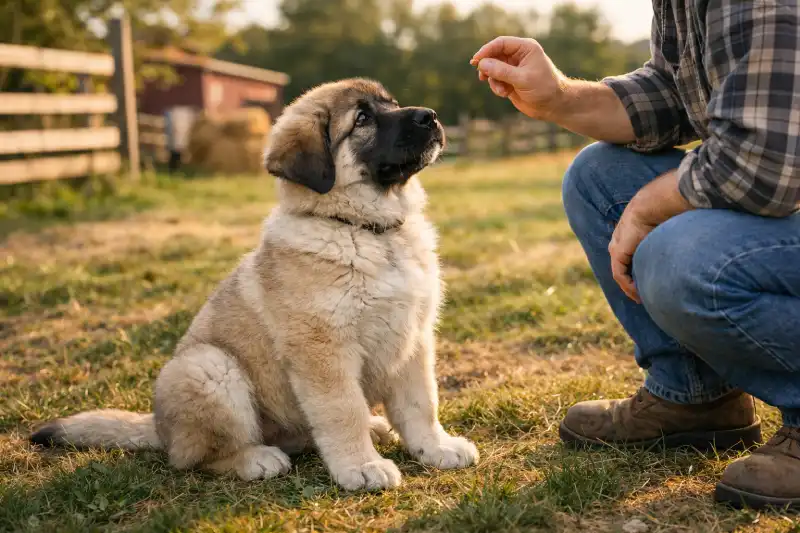
You’ve brought home an Anatolian Shepherd—a majestic, intelligent guardian with a mind of their own. Now you’re standing in your backyard, treat in hand, calling “come!” for the fifth time while your 90-pound puppy stares at you with an expression that clearly says, “I heard you. I’m just deciding if it’s worth my time.” Sound familiar?
Training an Anatolian Shepherd isn’t like training a Golden Retriever or a Border Collie. These ancient livestock guardians were bred for 6,000 years to make independent decisions, work without human direction, and protect their flock from wolves and bears. That independence, intelligence, and natural suspicion that makes them exceptional guardians also makes traditional training approaches frustratingly ineffective.
After working with dozens of Anatolian Shepherds over the past 15 years—from 8-week-old puppies to adult rescues—I’ve learned that training this breed requires a completely different mindset. You’re not commanding a servant; you’re negotiating with an intelligent partner who needs a good reason to cooperate.
Understanding the Anatolian Shepherd Training Challenge
Why Traditional Training Often Fails
Before we dive into what works, let’s understand why standard obedience training typically doesn’t work well with Anatolians:
- They’re not people-pleasers: Unlike breeds developed to work closely with humans, Anatolians were bred to work independently. They don’t have an innate drive to earn your approval.
- They question commands: An Anatolian’s first instinct is to assess whether your request makes sense given their understanding of the situation.
- They mature slowly: Mental maturity doesn’t arrive until 2-3 years old. That “teenage phase” is long and challenging.
- Repetition bores them: Drilling the same command 20 times in a row will make them tune you out, not learn faster.
- They’re conflict-avoidant with family: Harsh corrections damage your relationship and make them less likely to cooperate.
What Makes Anatolian Training Different
Successful Anatolian training is built on these principles:
- Mutual respect over dominance: You’re the leader, but leadership means being worthy of following, not forcing compliance.
- Quality over quantity: A few well-timed, meaningful training sessions beat hours of drilling.
- Real-world relevance: Commands that make practical sense get better responses than arbitrary tricks.
- Relationship-first approach: Your bond is your training foundation. Without trust and respect, nothing else works.
🐾 Expert Insight: I once worked with an owner who couldn’t understand why their Anatolian ignored “sit” commands. When I asked why the dog should sit, they had no answer—it was just something dogs should do. We reframed it as “sit before going through doors” (practical boundary management), and the dog caught on immediately. Context matters to this breed.
Foundation Training: The Essential First Steps
Start With Relationship Building (Birth to 6 Months)
Before you worry about commands, focus on building a relationship that makes your Anatolian want to work with you:
- Be their safe person: Handle them gently, protect them from overwhelming situations, and be predictable in your interactions.
- Hand-feed meals occasionally: This builds positive associations and teaches them that good things come from you.
- Play on their terms: Let them initiate play and respect when they’re done. Forcing interaction builds resentment.
- Respect their assessment time: When they encounter something new, give them time to observe before pushing them to interact.
- Be consistent: Anatolians thrive on predictable routines and clear expectations.
Socialization: Critical and Misunderstood
Proper socialization for an Anatolian doesn’t mean forcing them to love everyone. It means teaching them to be calm and neutral around new people, animals, and situations.
What good socialization looks like:
- Exposure to many different people, but no forced interactions
- Letting them observe and assess from a comfortable distance
- Rewarding calm, neutral behavior (not just friendly behavior)
- Keeping experiences positive—never overwhelming
- Continuing socialization throughout their life, not just puppyhood
What ruins socialization:
- Forcing them to greet every person or dog
- Taking them to overwhelming environments (busy dog parks, crowded festivals)
- Punishing their natural caution or reserve
- Exposing them to aggressive or rude dogs
- Stopping socialization after puppyhood
Real example: Eren, a 4-month-old Anatolian puppy, was taken to a busy dog park by well-meaning owners who wanted him to be “social.” He was overwhelmed by rude dogs who invaded his space. At 18 months, he became dog-aggressive. We had to spend months rebuilding his confidence through controlled, positive exposures. Prevention would have been so much easier.
House Training and Crate Training
Good news: Anatolians are typically easy to house train because they’re naturally clean and don’t like soiling their living space.
House training tips:
- Take them out frequently—every 2 hours for young puppies, after meals, after play, and first thing in the morning
- Use a consistent “bathroom spot” and praise calmly when they go
- Don’t punish accidents—just clean them thoroughly with enzyme cleaner
- Supervise constantly when they’re loose in the house
- Watch for sniffing, circling, or heading to corners—these signal they need to go out
Crate training considerations:
Crate training is valuable but needs careful implementation with Anatolians. They can be claustrophobic and don’t like feeling trapped.
- Use the largest crate practical—these are big dogs who need space
- Make it supremely comfortable with bedding, toys, and even a worn t-shirt with your scent
- Never use the crate as punishment
- Feed meals in the crate to build positive associations
- Start with short periods and gradually increase duration
- Consider an exercise pen as an alternative if they truly hate crates
Essential Commands for Anatolian Shepherds
Focus on commands that have real-world value and make sense to a guardian dog. Here are the non-negotiables:
1. Recall (Come When Called)
This is the most important and most challenging command for Anatolians. Their independent nature and territorial instincts work against coming when called.
How to build a reliable recall:
- Never call them for something negative: Don’t call them to come for nail trims, baths, or being put away. Go get them instead.
- Make coming to you the best decision ever: Use high-value treats (real chicken, cheese, hot dogs), enthusiastic praise, and immediate rewards.
- Start in low-distraction environments: Practice in your house and yard before trying in more challenging locations.
- Use a long line outdoors: A 30-foot training lead prevents them from learning that ignoring you is an option.
- Practice randomly throughout the day: Call them, reward, and release them to go back to what they were doing.
- Never punish slow recalls: If they take 30 seconds to come, still reward them. Punishing teaches them that coming to you is bad.
⚠️ Critical Warning: Never trust an Anatolian off-leash in unfenced areas, even with excellent recall. Their guardian instincts can override training if they perceive a threat. I’ve seen dogs with perfect recall ignore their owners when a coyote appeared. Safe containment is non-negotiable.
2. Leave It / Drop It
Teaching your Anatolian to leave things alone or release items prevents resource guarding and keeps them safe.
“Leave it” training:
- Hold a treat in your closed fist. When they stop pawing/mouthing it, immediately reward with a different treat
- Gradually increase difficulty—treat on the floor covered by your hand, then uncovered
- Add the verbal cue “leave it” only after they understand the concept
- Practice with increasingly tempting items in controlled settings
“Drop it” training:
- Trade for something better—when they have a toy, offer a high-value treat
- When they release the item, say “drop it,” give the treat, then return the toy
- This teaches them that dropping things gets them both the treat AND the item back
- Never chase them or forcefully take things—this creates resource guarding
3. Sit and Down
These basic commands become useful when tied to real-world scenarios:
- “Sit” before going through doors: Prevents rushing and establishes boundaries
- “Sit” for meals: Food motivation makes this easy to teach
- “Down” for grooming/vet exams: Makes handling easier
- “Down-stay” during family meals: Prevents begging
Training approach:
- Lure them into position with a treat held close to their nose
- Mark the behavior with “yes!” or a clicker the instant they do it
- Reward immediately
- Add the verbal cue after they reliably follow the lure
- Gradually phase out the lure but continue rewarding
4. Place/Go to Your Spot
This command is invaluable for managing your Anatolian during meals, when guests arrive, or when they need to settle.
- Choose a specific bed, mat, or crate as their “place”
- Lure them to it, say “place,” and reward when they step on it
- Gradually increase the duration they stay there
- Release with a specific word like “okay” or “free”
- Make it the best spot in the house—comfortable bedding, occasional special treats
5. Loose-Leash Walking
Teaching a 120+ pound dog not to pull on leash is essential for your safety and theirs.
Effective techniques:
- The “tree” method: The instant they pull, become a tree—stop moving entirely. Only proceed when the leash loosens.
- Direction changes: When they start to pull, change direction. This teaches them to pay attention to where you’re going.
- Reward frequently: Every few steps they walk nicely, mark and treat.
- Use proper equipment: Front-clip harnesses or head halters give you better control than collars.
- Exercise them first: A tired Anatolian walks more calmly than a fresh one.
Reality check: Anatolians aren’t natural heelers like some breeds. Expecting perfect heel position on every walk is unrealistic. Aim for manageable, safe walking where they’re not dragging you, even if they sometimes walk ahead or to the side.
Training Methods That Work (and Those That Don’t)
| Method | Effectiveness with Anatolians | Why/Why Not |
|---|---|---|
| Positive reinforcement | ✅ Highly effective | Builds relationship, respects their intelligence, makes cooperation worthwhile |
| Force/dominance-based | ❌ Counterproductive | Damages trust, can trigger defensive aggression, goes against their nature |
| Clicker training | ✅ Very effective | Precise communication, engages their problem-solving intelligence |
| Repetitive drilling | ❌ Ineffective | Bores them quickly, leads to disengagement and stubbornness |
| Short, varied sessions | ✅ Highly effective | Maintains interest, respects their attention span, makes training fun |
| Punishment-based | ❌ Damaging | Creates fear, destroys relationship, can cause aggression |
| Real-world practice | ✅ Essential | Makes commands relevant and meaningful |
Common Training Challenges and Solutions
Challenge 1: Selective Hearing
The problem: Your Anatolian clearly hears you but chooses not to respond.
Why it happens: They’re assessing whether your command makes sense given what they’re currently doing or observing.
Solutions:
- Only give commands you can enforce—if they’re off-leash in the yard and you can’t make them comply, don’t give the command
- Increase your reward value—maybe they’d respond for roast chicken even if they ignore kibble
- Move closer before giving the command—distance reduces compliance
- Reduce distractions when teaching new behaviors
- Build a stronger pattern of reinforcement—reward more frequently
Challenge 2: Teenage Regression (8-18 Months)
The problem: Your perfectly trained puppy suddenly “forgets” everything they learned.
Why it happens: Adolescent brain development, hormonal changes, increased independence, and growing guardian instincts all collide.
Solutions:
- Stay patient and consistent—this phase passes
- Go back to basics if needed—no shame in revisiting foundation training
- Increase exercise and mental stimulation
- Maintain your training schedule even when progress stalls
- Consider whether hormones are an issue—intact adolescents are more challenging
- Don’t take it personally—this is normal breed development
Personal experience: My own Anatolian, Aslan, was reliably house-trained at 4 months. At 10 months, he started marking corners in the house. I was mortified—had I failed? No. His maturing guardian instincts meant he was trying to “claim” his territory. We went back to basics, managed his access, and neutered him at 12 months. Problem solved.
Challenge 3: Protectiveness Interfering with Training
The problem: Your Anatolian won’t focus on training when people or animals are visible.
Why it happens: Their guardian instincts trump training in their priority hierarchy.
Solutions:
- Train in environments where they feel secure, not hyper-alert
- Work at greater distances from triggers
- Use extremely high-value rewards that compete with their guarding drive
- Teach an “all clear” cue—when you say it, they can relax their vigilance
- Consider whether they’re mature enough for training in challenging environments
Challenge 4: Resource Guarding
The problem: Your Anatolian growls, stiffens, or shows teeth when you approach their food, toys, or resting spots.
Why it happens: Guardian breeds naturally protect valuable resources. Poor handling can worsen this tendency.
Solutions:
- Never punish guarding behavior: This escalates the problem
- Teach that your approach means good things: Drop high-value treats near their bowl when passing
- Trade, don’t take: Offer something better in exchange for what they have
- Create abundance: Multiple toys, chews, and resources reduce competition feelings
- Respect their space: They need a safe spot where they won’t be bothered
- Consult a professional: Serious guarding requires expert intervention
🚨 When to Seek Professional Help: If your Anatolian shows aggression toward family members, bites, or exhibits guarding behavior that’s escalating, consult a veterinary behaviorist or certified dog behavior consultant (IAABC-certified) immediately. Don’t wait for someone to get hurt.
Advanced Training Considerations
Can Anatolians Do Dog Sports?
Yes, but choose carefully. Anatolians can excel in activities that align with their natural abilities:
- Carting/drafting: They’re built for endurance work
- Nose work/scent detection: Engages their excellent scenting ability
- Rally obedience: More flexible than traditional obedience, can work for patient handlers
- Farm work: Their original purpose—guarding livestock
Less suitable activities:
- Dog agility (not agile or motivated for this)
- Competitive obedience (too independent for precise heeling)
- Dog park play (guarding instincts create problems)
- Protection sports (unnecessary given natural abilities, can be dangerous)
Training for Real-World Guardian Work
If you’re using your Anatolian for their traditional purpose:
- Start them young with the livestock they’ll protect
- Supervise interactions until you’re confident in their behavior
- Teach them boundaries of their territory
- Ensure they’re bonded to both livestock and family
- Provide ongoing socialization so they don’t become overly reactive
- Work with experienced livestock guardian dog mentors
Training Tools and Equipment
What You Need
- Properly fitted harness or collar: Front-clip harnesses help with pulling; avoid choke or prong collars
- 6-foot leash for training: Gives control while allowing some freedom
- 30-foot long line: Essential for practicing recall safely
- High-value treats: Real meat, cheese, special training treats
- Treat pouch: Keeps rewards accessible
- Clicker (optional): For precise communication
- Comfortable mat or bed: For “place” training
What to Avoid
- Shock/e-collars: Damage trust and can create aggression
- Prong or choke collars: Can injure and damage your relationship
- Retractable leashes: Dangerous with large, strong dogs
- Physical corrections: Alpha rolls, scruff shaking, hitting—all harmful and ineffective
Age-Specific Training Guidelines
| Age Range | Training Focus | What to Expect |
|---|---|---|
| 8-16 weeks | Socialization, house training, basic handling, name recognition | Eager to learn, curious, short attention span |
| 4-6 months | Basic commands, leash walking, bite inhibition, continued socialization | Still very trainable but showing more independence |
| 6-12 months | Reinforcing basics, managing teenage rebellion, impulse control | Testing boundaries, selective hearing, energy peaks |
| 12-24 months | Guardian instincts emerging, managing protectiveness, advanced commands | Increasingly independent, territorial, requires patience |
| 2+ years | Maintaining training, managing mature guardian behaviors | Settled into personality, training patterns established |
Real-Life Success Stories
Case Study 1: From Reactive to Reliable
The Challenge: Luna, a 14-month-old female Anatolian, was reactive to other dogs on walks, lunging and barking aggressively.
The Approach:
- Identified her threshold distance (40 feet from other dogs before reacting)
- Used high-value treats (freeze-dried liver) to reward calm behavior at 50 feet
- Gradually decreased distance over 4 months
- Taught “watch me” command to redirect her focus
- Avoided confrontational situations while building skills
The Result: After 6 months of consistent work, Luna could pass other dogs at 10 feet without reacting, though she never became dog-social (not the goal). Her owner learned to read her body language and manage situations appropriately.
Case Study 2: Rescue Dog Rehabilitation
The Challenge: Baran, a 3-year-old male rescue, had zero training, didn’t know his name, and was fearful of men.
The Approach:
- Started with relationship building—no formal training for the first month
- Hand-fed all meals to build trust
- Introduced very basic commands in low-stress environments
- Used only male trainers/helpers he could observe from a distance with high-value rewards
- Gave him total choice in interactions—never forced
The Result: Within a year, Baran was a reliable family companion who knew basic commands, could walk nicely on leash, and tolerated (though didn’t love) male visitors. The key was patience and respecting his timeline.
Case Study 3: Working Guardian Training
The Challenge: Zeynep and her sibling were being trained to guard goats but showed predatory interest in the kids (baby goats).
The Approach:
- Introduced them to goats at 10 weeks old under close supervision
- Corrected any chasing or rough play immediately but gently
- Rewarded calm, gentle behavior around the herd
- Lived with the goats full-time from 4 months on
- Provided ongoing socialization with people to prevent overprotectiveness
The Result: By 18 months, both dogs were reliable guardians who protected the herd from coyotes and predatory birds while being gentle with newborn kids. They responded to their owner’s calls and could be handled for vet care.
💡 Training Truth: Every single successful Anatolian owner I’ve worked with has one thing in common: they accepted their dog’s nature instead of trying to change it. They worked WITH the breed’s instincts, not against them. That’s the real secret to training success.
Maintaining Training Throughout Life
Training isn’t something you finish—it’s an ongoing relationship with your Anatolian.
Daily Training Integration
- Sit before meals: 5 seconds of training twice daily
- Wait at doors: Impulse control practice every time you enter/exit
- Random recalls during yard time: Keeps the command fresh
- Place during family meals: Reinforces boundaries
- Calm greetings: Practice whenever someone arrives
Weekly Training Sessions
- 15-minute sessions 2-3 times per week
- Review basic commands
- Introduce new challenges or tricks
- Practice in different environments
- Address any developing issues early
Ongoing Socialization
- Regular exposure to different people, places, and situations
- Continued positive experiences with the vet, groomer, etc.
- Controlled interactions with dog-savvy people
- Varied walking routes to prevent territorial behavior from intensifying
See also: [Understanding Anatolian Shepherd Body Language] | [Anatolian Shepherd Exercise Needs] | [Managing Guardian Breed Behavior]
Frequently Asked Questions
At what age should I start training my Anatolian Shepherd?
Start the moment you bring your puppy home, typically at 8 weeks old. However, “training” at this age means socialization, gentle handling, and creating positive associations—not formal obedience. Basic commands like name recognition and house training can begin immediately, but keep sessions extremely short (2-3 minutes) and fun. The critical socialization window closes around 16 weeks, so prioritize positive exposure to people, places, and appropriate dogs during this time. Formal training can intensify around 4-6 months, but always match your expectations to their developmental stage.
Can you train an Anatolian Shepherd to be off-leash reliable?
Honest answer: not in the way you can train a Border Collie or Lab. Anatolians can have excellent recall in controlled environments like a fenced yard or familiar property, but their guardian instincts mean they’ll prioritize perceived threats over your commands. I’ve seen Anatolians with years of perfect recall completely ignore their owners when a coyote appeared or when they spotted something concerning at a distance. For safety, always use physical containment (fences) or leashes in unfenced areas, regardless of training level. You can train them to come when called 95% of the time, but that 5% could be life-threatening.
My Anatolian is stubborn and won’t listen—how do I fix this?
First, reframe your thinking: they’re not stubborn, they’re independent decision-makers. The “fix” isn’t forcing compliance but making cooperation more rewarding than independence. Ask yourself: Are your rewards valuable enough? Are you being consistent? Have you built a strong relationship foundation? Are your commands clear and relevant? Sometimes what looks like stubbornness is actually confusion, lack of motivation, or the dog reasonably prioritizing something more important (like territorial vigilance). Increase your reward value, simplify your requests, train in lower-distraction environments, and ensure you’re giving commands you can actually enforce. If problems persist, consult a trainer experienced with guardian breeds.
How long does it take to train an Anatolian Shepherd?
There’s no finish line—training is lifelong. That said, basic obedience (sit, down, come, stay, leash walking) typically takes 6-12 months to establish reliably, though you’ll need to maintain and reinforce these skills forever. Anatolians mature slowly, with full mental maturity not arriving until 2-3 years old, so behaviors you think are “trained” may need revisiting during adolescence. The real question isn’t “how long until they’re trained?” but “am I committed to ongoing training throughout their 10-12 year lifespan?” If you’re looking for a dog that learns quickly and stays trained with minimal reinforcement, this isn’t the breed for you.
Should I use a professional trainer for my Anatolian Shepherd?
Yes, especially if this is your first guardian breed. However, choose carefully—many trainers have no experience with livestock guardians and will apply methods that work for Labs or German Shepherds but backfire spectacularly with Anatolians. Look for trainers who: (1) have specific experience with guardian breeds, (2) use positive reinforcement methods, (3) understand that Anatolians aren’t “broken” dogs needing “fixing,” and (4) can teach YOU how to work with your dog’s nature. Avoid anyone who uses dominance theory, punishment-based methods, or promises to “break” your dog’s stubbornness. A good trainer empowers you to understand and communicate with your Anatolian, not just issues commands.
What’s the biggest training mistake Anatolian Shepherd owners make?
Treating them like a typical pet dog breed and expecting instant, enthusiastic obedience. When owners approach training with frustration because their Anatolian doesn’t behave like their friend’s Golden Retriever, they create a negative spiral: they get frustrated → dog senses tension → dog becomes less cooperative → owner gets more frustrated. The solution is accepting that Anatolians are fundamentally different. They’re thinking dogs who need to understand WHY, not just WHAT. They require patience, respect, and training approaches that honor their intelligence and independence. Owners who succeed are those who appreciate these differences rather than resenting them.
Can Anatolian Shepherds be trained to get along with other pets?
Yes, but with important caveats. Anatolians raised with other pets from puppyhood typically accept those specific animals as part of their “flock” to protect. However, their tolerance usually doesn’t generalize to ALL animals of that type. For example, an Anatolian who lives peacefully with your family cats might still view neighborhood cats as intruders. Training focuses on management and supervision rather than creating a naturally social dog. They can learn to tolerate (or ignore) other pets through careful introduction, positive associations, and clear boundaries, but forcing friendliness often backfires. Some Anatolians, particularly intact males or those with strong prey drive, may never be safe with smaller pets regardless of training.
Conclusion
Training an Anatolian Shepherd successfully requires releasing any preconceived notions about how dogs “should” behave and embracing what makes this ancient breed remarkable. They’re not broken dogs who need fixing, stubborn animals requiring domination, or blank slates waiting to be programmed. They’re intelligent, independent partners who will work with you beautifully—when you earn their respect and make cooperation worthwhile.
The owners who thrive with Anatolians are those who appreciate that their dog is thinking, assessing, and making decisions. They understand that training isn’t about commanding obedience but building a relationship where their Anatolian chooses to listen because they trust and respect their human.
Yes, training an Anatolian requires more patience, creativity, and flexibility than many other breeds. But the reward is a loyal, capable guardian who will protect your family, respect your leadership, and amaze you with their intelligence and devotion. When you work WITH their nature instead of against it, you’ll discover that Anatolians aren’t difficult to train—they’re simply trained differently.
Start where you are. Be patient with yourself and your dog. Celebrate small victories. Seek help when you need it. And remember: the journey of training an Anatolian Shepherd isn’t about reaching perfection—it’s about building a partnership that grows stronger every day.
Remember: Every Anatolian is an individual. What works perfectly for one dog might need adjustment for another. Stay flexible, observe your dog, and adapt your approach to their unique personality and needs.
🐾 Author Bio
Written by: Sarah Mitchell, Dog Care Writer at https://anatolianshepherd.me/
Dog behavior specialist and guardian breed enthusiast with over 15 years of hands-on experience training and living with livestock guardian dogs, including Anatolian Shepherds, Kangals, Great Pyrenees, and Maremmas. Passionate about helping owners understand what makes guardian breeds unique and how to work with—not against—their natural instincts.
Content reviewed using certified professional dog trainer knowledge (CPDT-KA principles), veterinary behavioral science, and real experiences from dozens of Anatolian Shepherd owners to ensure practical, breed-appropriate training advice that actually works in the real world.